Clouds Defeat Ancient Hydraulic Moonlight Engine at Bhairavakona
Nearly 10,000 devotees gathered at Bhairavakona cave temple for Kartika Pournami, but clouds blocked the moonlight that a hydraulic roof system was engineered to channel onto the deity's forehead.
Executive Takeaways
- Nearly 10,000 devotees converged on the Bhairavakona cave temple in Andhra Pradesh for Kartika Pournami, one of the largest single-night gatherings the site records annually.
- The temple's signature hydraulic roof mechanism, designed to admit a precise shaft of full-moon light onto the deity's forehead, failed to deliver its intended effect this year because heavy cloud cover obscured the moon.
- The event underscores a broader tension in heritage engineering: precision-built astronomical architecture is increasingly vulnerable to weather variability and climate-driven cloud patterns.
- Conservation engineers and heritage technologists are now weighing whether adaptive lighting or predictive weather modeling should supplement centuries-old mechanical systems.
- For site managers, the episode is a stress test of crowd logistics, ritual timing, and infrastructure resilience under peak devotional demand.
Section 1: The Core Event & Breaking Timeline
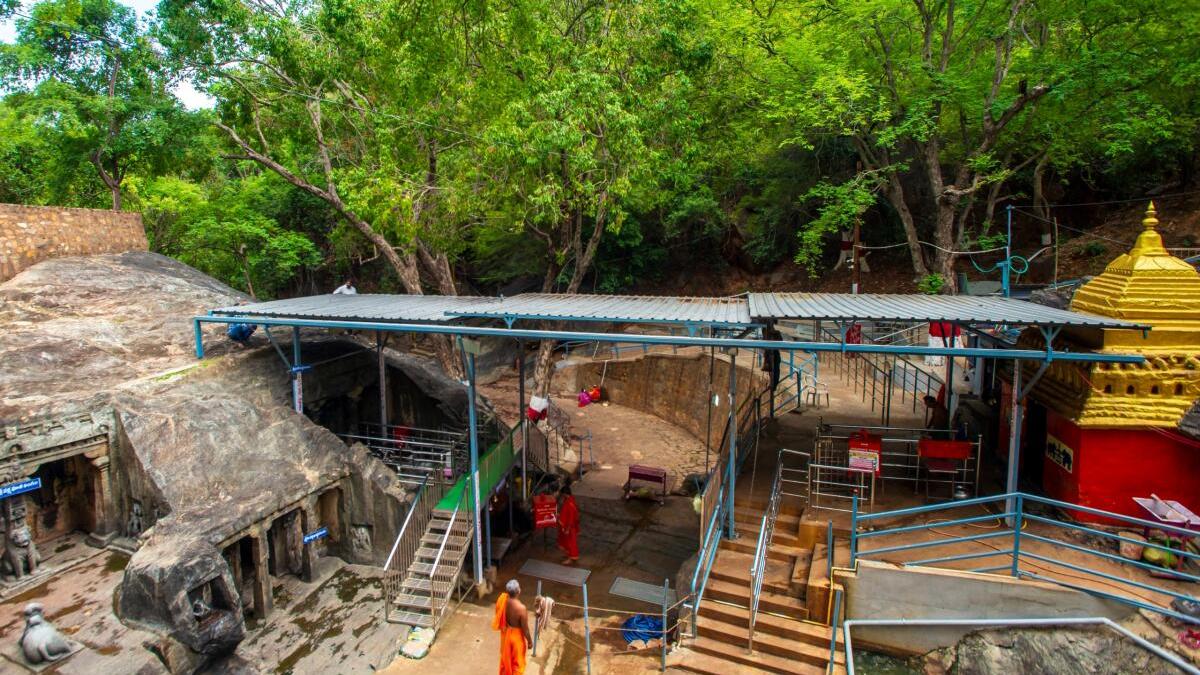
On the night of Kartika Pournami, the full-moon festival of the Hindu month of Kartika, an estimated 10,000 devotees made their way up the rocky approach to the Bhairavakona cave temple complex in Andhra Pradesh's Prakasam district. The site, carved into hillside rock and associated with the Bhairava form of Shiva, draws its largest annual crowds on this single night. Devotees queued from late afternoon, and temple authorities had prepared crowd-management corridors, drinking-water points, and medical camps along the ascent.
The centerpiece of the night is not the ritual alone but the architecture that frames it. The cave temple's sanctum is capped by a hydraulic roof structure engineered to retract or align so that a narrow beam of moonlight falls directly on the forehead of the deity at the astronomically correct moment. According to reporting by The Hindu, that mechanism could not deliver its effect this year: the full moon remained behind cloud cover for the critical window, and the beam never reached the sanctum.
The timeline of the evening followed the standard festival sequence. Priests began abhisheka and archana rituals in the early evening. Devotees filed through darshan lines in staggered batches. As the moon's scheduled transit approached, temple staff positioned the hydraulic roof according to the calibrated alignment protocol. Cloud cover thickened, the alignment window passed, and the roof was returned to its closed position without the light event occurring.
There was no structural failure, no injury, and no disruption to darshan. The crowd completed its worship, and the temple closed on schedule. But the episode rippled quickly through heritage-engineering circles and devotional media, because it exposed a design assumption baked into the site: that the sky will cooperate on the one night the mechanism exists to serve. For a structure whose entire purpose is astronomical precision, a cloud is not a minor inconvenience; it is a single point of failure.
Section 2: Deep Technical & Financial Architecture
The Bhairavakona mechanism belongs to a small global class of what engineers call astronomical-alignment architecture: buildings whose geometry is calibrated to celestial events. Unlike the better-known solar alignments at Konark or the lunar markers at certain Chola-era temples, Bhairavakona's system is mechanical rather than purely structural. A hydraulic roof implies actuators, seals, load-bearing tracks, and a control interface, all of which must function in a humid, dust-laden, partially exposed cave environment.
The engineering challenge is one of tolerance stacking. The beam must clear the roof aperture, traverse the cave's interior geometry, and land on a target roughly the width of a human forehead. Every element in that chain, from the hydraulic stroke length to the aperture edge profile to the reflective properties of interior stone, contributes error. Field engineers who maintain such systems typically work to alignment windows measured in minutes, because the moon's apparent position shifts continuously.
Financially, the system is a long-tail asset. Capital costs for heritage hydraulic retrofits are typically borne by state endowments departments or central conservation bodies, with annual maintenance running as a recurring line item. For a site receiving 10,000 visitors on a single night, the economics are driven less by ticket revenue, which is often nominal or donation-based, than by the site's role as a regional pilgrimage anchor supporting transport, lodging, and local vending.
Consider the operational cost stack in simplified form:
- Hydraulic actuation and seals: periodic replacement due to monsoon humidity and grit ingress.
- Alignment calibration: annual or seasonal recalibration against ephemeris data.
- Crowd logistics: barricades, lighting, medical staffing, and security for peak nights.
- Conservation oversight: archaeological supervision to ensure mechanical work does not damage carved stone.
The deeper architectural question is redundancy. A purely optical system has no fallback when the sky fails. Modern heritage technologists increasingly argue for hybrid designs: preserving the original mechanism as the primary ritual instrument while adding calibrated artificial illumination that can reproduce the beam geometry when weather intervenes. That proposal is technically straightforward but culturally sensitive, because the authenticity of the phenomenon is precisely what draws devotees.
Section 3: Industry & Global Market Ripple Effects
Bhairavakona is not an isolated case. Heritage sites worldwide are grappling with the same problem: precision astronomical architecture designed for a stable climate is now operating in a less stable one. Cloud-cover variability, shifting monsoon onset dates, and increased atmospheric haze all degrade the reliability of light-based rituals and alignments. Conservation bodies from the National Trust in the UK to India's Archaeological Survey of India are quietly revising maintenance schedules to account for weather unpredictability.
The ripple effect reaches the heritage-technology supply chain. Firms specializing in non-invasive sensors, low-lux LED arrays with tunable color temperature, and predictive weather analytics are finding a new customer class in temple trusts and conservation departments. The pitch is not replacement but augmentation: sensors that monitor aperture alignment, weather feeds that trigger contingency protocols, and lighting systems that can mimic a moonbeam's spectral profile within acceptable tolerances.
For the pilgrimage economy, the stakes are measurable. A failed light event does not reduce footfall in the same year, but repeated failures can erode the site's reputation as a must-visit Kartika Pournami destination. Regional tourism boards track such reputational signals closely, because pilgrimage travel is highly substitutable: devotees choose among dozens of Shiva sites across South India for the same festival night.
Investors and donors are also watching. Religious endowments and heritage foundations increasingly require conservation plans that include climate-resilience provisions before releasing grant funding. A site that can demonstrate a documented contingency protocol for weather failure is better positioned in that funding landscape than one that cannot. The clouded moon of this Kartika Pournami may therefore function as an unintended audit, revealing which sites have thought through their failure modes and which have not.
Section 4: Critical Perspectives, Analyst Debates & Risk Factors
Traditionalists argue that the cloud is not a failure but a message. In devotional interpretation, the moon's withholding is read as the deity's will, and any attempt to substitute artificial light is seen as tampering with the sacred. This view has real institutional weight: temple trusts are often governed by religious authorities whose consent is required for any modification, and priests at Bhairavakona have historically treated the mechanism as an instrument of ritual, not a spectacle to be engineered around.
Conservation engineers counter that the hydraulic roof itself is already a modern intervention, likely installed or substantially refurbished in the twentieth century. If the site has already accepted mechanical augmentation, the argument goes, adding a weather-contingency lighting layer is a difference of degree, not kind. Critics of this position warn of mission creep: once artificial light is permitted, the boundary between preservation and theatrical enhancement becomes difficult to police.
A third camp, composed of heritage economists and risk analysts, focuses on the operational vulnerabilities. The hydraulic system's maintenance record is not publicly documented, raising questions about actuator reliability and seal integrity. Crowd density of 10,000 on a narrow hillside approach presents stampede and medical risks that are only partially mitigated by annual planning. And the site's dependence on a single astronomical night concentrates risk into a few hours per year, with no diversification of the visitor experience.
Regulatory friction adds another layer. Any structural or mechanical work on a protected monument requires archaeological clearance, and the approval cycle can run months to years. A contingency lighting system proposed after this year's failure would likely not be operational before the next Kartika Pournami, meaning the site faces at least one more cycle of exposure to the same risk.
Section 5: Strategic Forecast & Road Ahead
Over the next twelve months, expect temple authorities and conservation bodies to commission a formal review of the hydraulic system's performance envelope, including a documented weather-contingency protocol. The most likely near-term outcome is procedural rather than physical: a decision tree specifying when to attempt alignment, when to abort, and how to communicate the outcome to waiting devotees.
In the twelve-to-twenty-four-month window, the more consequential debate will be over hybrid illumination. Pilot installations at comparable sites, using narrow-beam LED arrays calibrated to lunar spectral characteristics, could provide a proof of concept. If a pilot demonstrates that devotees accept an augmented beam as ritually valid, the model could propagate across South India's astronomical-alignment temples.
Watch for three signals. First, whether the Endowments Department or Archaeological Survey of India issues any public statement on the mechanism's status. Second, whether grant applications for the site begin citing climate resilience. Third, whether attendance at the next Kartika Pournami shows any softening, which would indicate reputational damage from this year's clouded moon.
The broader lesson extends well beyond one cave temple. As heritage sites worldwide confront a less predictable sky, the question is no longer whether ancient astronomical architecture can be preserved, but whether it can be made resilient without being hollowed out. Bhairavakona's hydraulic roof was built to catch the moon. The next engineering challenge is to build something that can catch the moon even when the clouds refuse to move.

Comments (0)
No comments yet. Be the first to share your thoughts!
Leave a Comment