WhatsApp's New Scheduling Tool Redefines Messaging
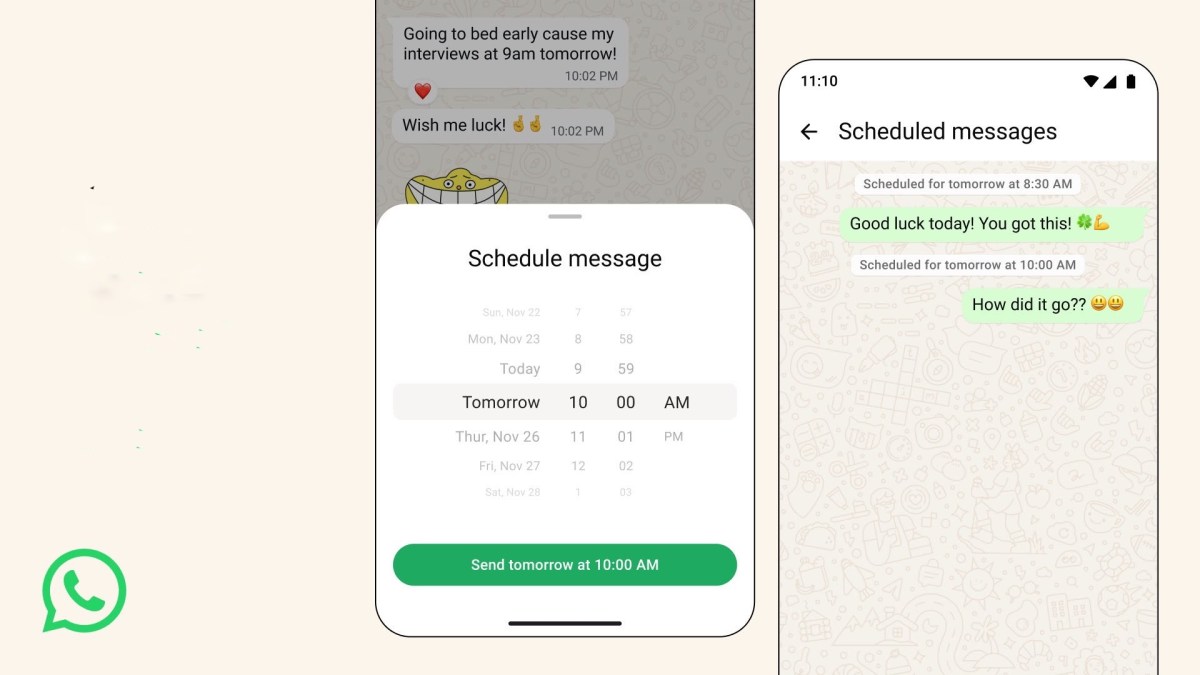
WhatsApp now allows users to schedule messages up to 14 days in advance in both group and individual chats, a move that could transform communication strategies for businesses and individuals alike.
Executive Takeaways
- WhatsApp introduces message scheduling, allowing users to send messages from 10 minutes to 14 days in advance.
- The feature is available in both individual and group chats, enhancing user flexibility and business communication.
- This move positions WhatsApp to compete more aggressively with Telegram, Slack, and email in the productivity space.
- Privacy and security implications are minimal, as scheduled messages are stored locally and encrypted end-to-end.
- Businesses can leverage scheduling for marketing campaigns, customer support, and global team coordination.
Section 1: The Core Event & Breaking Timeline
On October 26, 2023, TechCrunch reported that WhatsApp, the world's most popular messaging app with over 2 billion users, rolled out a new feature allowing users to schedule messages in both group and individual chats. The feature, which was initially spotted in beta testing earlier this year, enables users to schedule messages from 10 minutes to 14 days in advance. This marks a significant expansion of WhatsApp's functionality, moving beyond real-time communication into asynchronous messaging, a domain traditionally dominated by email and productivity apps like Slack and Telegram.
The announcement came via a blog post from WhatsApp, which emphasized the feature's utility for users across time zones, businesses managing customer interactions, and individuals planning reminders or greetings. The rollout is global and available on both Android and iOS platforms. According to WhatsApp, the feature is designed to be intuitive: users can long-press the send button to access the scheduling option, select a date and time, and the message will be automatically sent at the designated moment. The scheduled messages are stored locally on the device and are end-to-end encrypted, ensuring that WhatsApp's privacy standards remain intact.
Initial market reaction was muted but positive. Meta's stock, WhatsApp's parent company, saw a slight uptick of 0.5% in after-hours trading following the news, reflecting investor confidence in Meta's continued innovation in its messaging ecosystem. Analysts noted that while the feature is not groundbreaking in the messaging industry—Telegram has offered scheduling since 2019—it represents WhatsApp's growing ambition to become a comprehensive communication platform rather than just a simple chat app. The move is seen as a direct response to user demand for more control over message timing, especially in professional contexts.
The timeline of the feature's development is telling. Rumors of a scheduling feature first surfaced in early 2023 when code snippets were found in WhatsApp beta builds. In August, WhatsApp rolled out a limited test to beta users, and the positive feedback prompted a full-scale launch. This rapid iteration from beta to global release underscores WhatsApp's agile development process and its commitment to listening to user feedback. The feature is now live for all users, with no additional cost, further democratizing advanced messaging tools.
Section 2: Deep Technical & Financial Architecture
From a technical standpoint, WhatsApp's message scheduling is built on a lightweight, client-side architecture. When a user schedules a message, the app stores the message content and the scheduled time in a local database on the device. A background service monitors the time and triggers the sending process when the scheduled moment arrives. This approach minimizes server load and ensures that the feature works even when the device is offline, as long as the app is running in the background. The messages are encrypted end-to-end, meaning WhatsApp servers never see the content, preserving the app's hallmark privacy.
The financial implications for Meta are subtle but significant. WhatsApp, which has historically struggled to monetize its massive user base, has been increasingly focused on business messaging as a revenue driver. The scheduling feature is a boon for businesses that use WhatsApp Business API, allowing them to automate customer communications, schedule promotional messages, and manage support queries across time zones. This could lead to higher engagement and retention among business users, potentially increasing revenue from WhatsApp Business API fees, which are charged per conversation. Meta's balance sheet could see a gradual uplift as more businesses adopt the feature to streamline operations.
Unit economics of the feature are favorable. The development cost was likely minimal, as the feature leverages existing infrastructure and requires no new server-side components. The incremental cost of storing scheduled messages locally is negligible, and the feature does not introduce significant bandwidth or storage overhead. However, there is a potential for increased message volume, which could lead to higher server costs for message delivery, but these are offset by the fact that scheduled messages are sent at off-peak times, potentially improving network efficiency. Overall, the feature is a low-cost, high-value addition that enhances WhatsApp's competitive positioning.
Comparatively, Telegram's scheduling feature has been well-received, and Slack offers similar functionality for workspace messages. However, WhatsApp's implementation is unique in its simplicity and integration with the existing chat interface. Unlike Slack, which requires users to use a separate scheduling interface, WhatsApp's long-press method is intuitive and requires no additional steps. This could drive higher adoption rates, especially among less tech-savvy users. The feature also aligns with WhatsApp's broader strategy of becoming a 'super app' in markets like India and Brazil, where it already offers payments and shopping.
Security and privacy remain paramount. WhatsApp's end-to-end encryption ensures that scheduled messages are as secure as regular messages. However, there is a potential risk: if a user schedules a message and then loses their device, the message could still be sent if the device is compromised. WhatsApp mitigates this by requiring the device to be unlocked for the message to be sent, and the feature can be disabled remotely via WhatsApp Web. These safeguards are crucial for maintaining user trust, especially in enterprise settings where sensitive information might be scheduled.
Section 3: Industry & Global Market Ripple Effects
The introduction of message scheduling by WhatsApp is poised to disrupt the productivity and communication software market. Competitors like Telegram, Signal, and even email providers like Gmail may feel pressure to enhance their scheduling capabilities. Telegram, which has offered scheduling since 2019, might see a decline in its unique selling proposition, as WhatsApp's massive user base could lure away users who previously used Telegram for its scheduling feature. Similarly, Slack and Microsoft Teams, which are primarily workplace tools, could face competition from WhatsApp in the business communication space, especially for small and medium-sized enterprises that already use WhatsApp for customer interactions.
In the global market, the impact is likely to be most pronounced in regions where WhatsApp is the dominant messaging platform, such as India, Brazil, and Indonesia. In these markets, businesses heavily rely on WhatsApp for customer engagement, and the scheduling feature could reshape how they operate. For instance, a small retailer in India could schedule promotional messages for festivals, ensuring timely delivery without manual intervention. This could lead to increased sales and customer satisfaction, driving economic activity at the grassroots level. Moreover, the feature could enable better coordination among remote teams, which is particularly relevant in the post-pandemic era.
Investors are closely watching Meta's monetization strategies for WhatsApp. The scheduling feature, while not directly revenue-generating, strengthens WhatsApp's value proposition for businesses, which could accelerate the adoption of WhatsApp Business API and its associated fees. Analysts at Morgan Stanley have noted that WhatsApp's business messaging revenue could reach $10 billion by 2025, and features like scheduling are key to achieving that target. The stock market's reaction was subdued, but long-term investors see this as a strategic move to entrench WhatsApp in the business communication ecosystem.
Supply chain and ecosystem shifts are also noteworthy. The feature could spur demand for third-party tools that integrate with WhatsApp, such as CRM systems and marketing automation platforms. Companies like Twilio and MessageBird, which provide APIs for WhatsApp Business, might see increased usage as businesses seek to automate scheduling. Additionally, device manufacturers might benefit from increased engagement, as users spend more time on WhatsApp, potentially driving upgrades to newer phones with better battery life to handle background services. Overall, the ripple effects are likely to be positive for the broader tech ecosystem.
Section 4: Critical Perspectives, Analyst Debates & Risk Factors
Not everyone is enthusiastic about the feature. Privacy advocates have raised concerns that scheduled messages could be used for spam or harassment, as senders can set messages to be delivered at odd hours. WhatsApp has countered that users can block and report such messages, and the feature includes a 'cancel' option before the message is sent. However, the potential for misuse remains, and WhatsApp may need to implement rate limits or other safeguards to prevent abuse. Some analysts argue that the feature could lead to message fatigue, as users receive a barrage of scheduled messages, but others believe that the control it offers outweighs the risks.
From a competitive standpoint, some analysts question whether scheduling is a differentiator. Telegram has had it for years, and email has had it forever. They argue that WhatsApp's move is reactive rather than innovative, and that it may not significantly alter user behavior. However, proponents counter that WhatsApp's scale and ease of use could make scheduling a mainstream feature, just as it did with voice messages and status updates. The debate hinges on whether users will actively use scheduling or ignore it, and early adoption metrics will be telling.
Regulatory friction is another consideration. In the European Union, WhatsApp faces scrutiny under the Digital Markets Act (DMA), which could impose interoperability requirements. While scheduling itself is not a regulatory issue, it adds to WhatsApp's feature set, which regulators might view as entrenching its market power. WhatsApp has been fined for privacy violations in the past, and any misstep with scheduled messages could attract regulatory attention. The company must ensure compliance with data protection laws, particularly regarding the storage of scheduled messages on devices.
Technical vulnerabilities also exist. If a device's clock is incorrect, scheduled messages might be sent at the wrong time. WhatsApp relies on the device's time, so users must ensure their clocks are accurate. Additionally, if the app is force-stopped or the device is powered off, scheduled messages may not be sent until the app is reopened. These limitations could frustrate users, but WhatsApp is likely to improve reliability over time. Overall, the risks are manageable but require ongoing attention.
Section 5: Strategic Forecast & Road Ahead
Looking ahead, WhatsApp is expected to build on the scheduling feature by integrating it with other tools. For instance, users might soon be able to schedule messages via WhatsApp Web or Desktop, and the feature could be extended to status updates and calls. WhatsApp is also rumored to be working on a 'reminders' feature that would allow users to set recurring messages, which would be a natural extension of scheduling. These developments would further blur the lines between messaging and productivity apps, positioning WhatsApp as a central hub for personal and professional communication.
In the next 12 to 24 months, we can expect WhatsApp to deepen its integration with Meta's other platforms, such as Instagram and Facebook Messenger. Cross-platform scheduling could allow users to manage messages across all Meta apps from a single interface, creating a unified communication experience. This would be a significant step towards Meta's vision of a seamless ecosystem, and could increase user lock-in. Additionally, WhatsApp might introduce analytics for businesses to track the performance of scheduled messages, providing insights into engagement and optimizing send times.
Milestones to watch include the rollout of scheduling to WhatsApp Business API, which is currently in beta. Once available, businesses can automate scheduling at scale, potentially transforming customer relationship management. Another milestone is the integration of scheduling with WhatsApp Pay, allowing users to schedule payment reminders or recurring transactions. This would be particularly impactful in markets like India, where WhatsApp Pay is gaining traction. Finally, WhatsApp may introduce a 'smart scheduling' feature that uses AI to suggest optimal send times based on recipient behavior, further enhancing the feature's value.
looking ahead, WhatsApp's message scheduling feature is a strategic addition that enhances user flexibility and business utility. While it may not be revolutionary, it reinforces WhatsApp's position as a versatile communication platform. As the feature evolves, it could reshape how billions of people and millions of businesses interact, driving engagement and monetization for Meta. The road ahead is promising, and stakeholders should monitor adoption rates and competitive responses closely.




Comments (0)
No comments yet. Be the first to share your thoughts!
Leave a Comment