Cartagena Siege Ends: Tech Response Behind 17-Hour Hostage Rescue
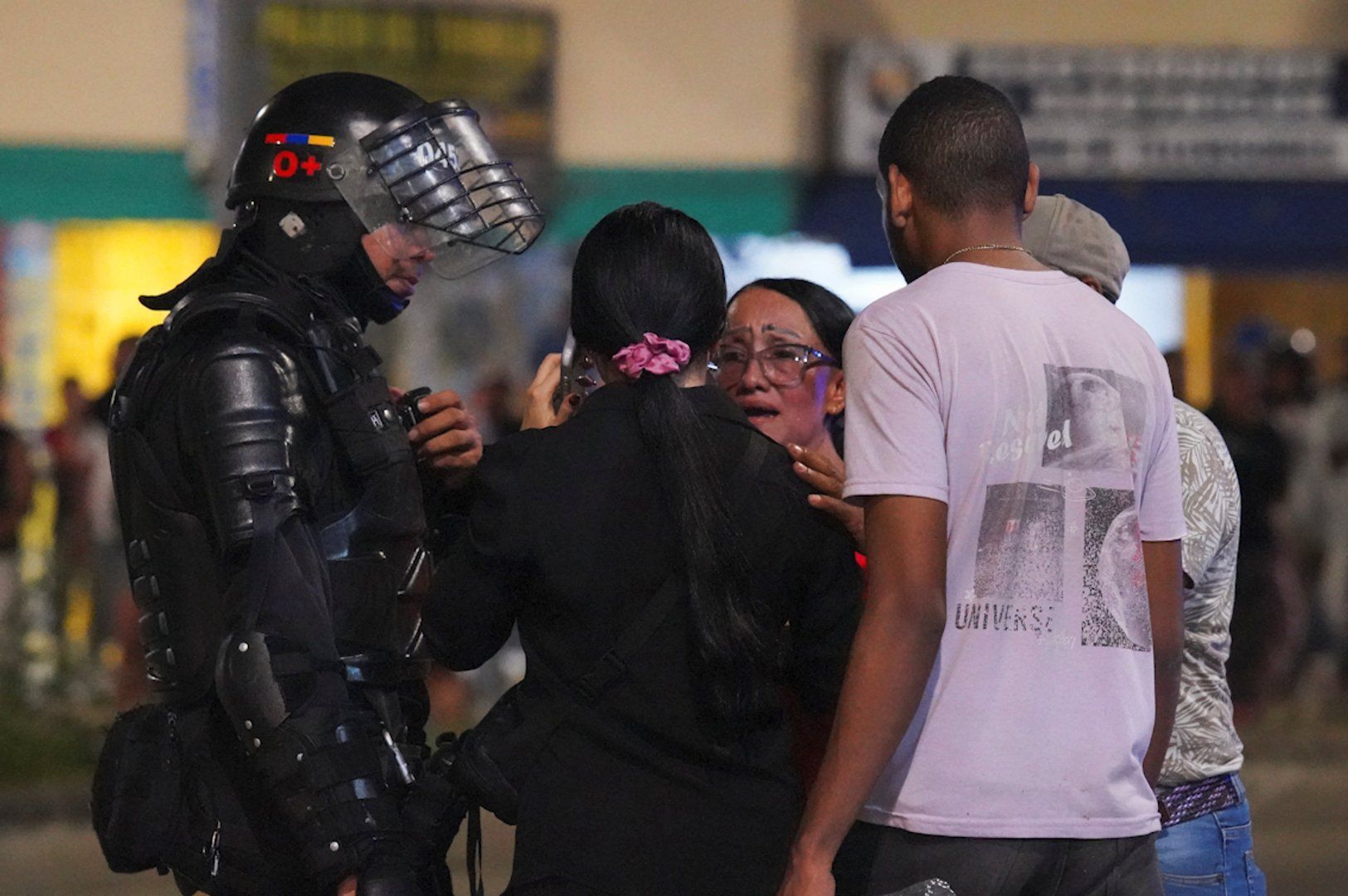
Colombian forces ended a 17-hour siege at a Cartagena supermarket, rescuing all hostages. The operation spotlighted surveillance, communications and crisis-response technology under real-world pressure.
Executive Takeaways
- Resolution: Colombian forces rescued all hostages after a 17-hour siege at a supermarket in Cartagena, ending a prolonged standoff without reported loss of hostage life.
- Technology under pressure: The incident offers a rare live test of surveillance, communications and command-and-control systems used by urban security forces.
- Market context: Public-safety technology spending is a resilient, policy-driven segment of the security market, insulated from consumer cyclicality.
- What to watch: Post-incident reviews will shape procurement priorities for surveillance analytics, encrypted radios and crisis-management software across Latin American cities.
Section 1: The Core Event & Breaking Timeline
The standoff in Cartagena, one of Colombia's most visited port cities, began as a localized criminal incident and escalated into a 17-hour siege at a supermarket, according to a breaking dispatch from Al Jazeera. Colombian forces ultimately rescued all hostages, closing out an operation that stretched through the night and into the following day. The core facts are stark and consequential: a prolonged confinement of civilians, a sustained security perimeter, and a resolution achieved through force rather than negotiation alone.
Timeline reconstruction matters here because duration is the single most important variable in hostage-crisis outcomes. A 17-hour window implies an initial containment phase, a negotiation or intelligence-gathering phase, and a final tactical assault or entry. Each phase draws on a distinct technology stack: perimeter surveillance and drone overwatch during containment; intercepted communications and biometric identification during intelligence gathering; and synchronized, encrypted command links during the final breach.
Initial market and institutional reaction was muted in the way that localized security incidents typically are. There is no direct equity-market transmission mechanism from a single retail siege, and no listed company disclosed exposure. The more meaningful reaction is institutional: municipal authorities and national police commands will face immediate questions about response time, intelligence quality and the adequacy of surveillance coverage in high-footfall commercial zones.
For technology and finance readers, the relevant framing is not the crime itself but the operational infrastructure that resolved it. Urban security is increasingly a data problem: camera density, video analytics, radio interoperability and real-time command dashboards determine how quickly a perimeter becomes a plan. The Cartagena outcome — all hostages rescued — will be read by procurement officials across the region as evidence for or against specific systems.
Section 2: Deep Technical & Financial Architecture
The technical architecture behind a modern urban hostage response rests on four layers. First, sensing: fixed CCTV, thermal imaging and increasingly drone-based aerial overwatch. Second, transport: encrypted digital radio networks and redundant cellular backhaul. Third, analytics: video management systems with motion and object-detection models that flag movement inside a structure. Fourth, command: incident-management software that fuses feeds into a common operating picture for on-scene commanders.
Unit economics of these systems have shifted decisively over the past decade. Historically, city surveillance deployments were capital-intensive, dominated by proprietary camera hardware and closed video-management platforms. The migration to IP cameras and software-defined video management has compressed hardware costs while pushing value into analytics subscriptions and integration services. For vendors, the recurring-revenue share of public-safety contracts has risen steadily, improving margin visibility.
Balance-sheet impact for the sector is asymmetric. Municipal buyers face budget cycles and procurement rules that delay deployment, while national police and military buyers can move faster under emergency authorities. Vendors with exposure to Latin American public safety therefore carry lumpy revenue recognition and elevated receivables risk, offset by multi-year service contracts that extend beyond political transitions.
Interoperability remains the weakest link. In practice, the failure mode in complex incidents is rarely a lack of cameras; it is the inability of agencies to share feeds and voice channels in real time. Standards-based radio (P25 in North America, TETRA in Europe and much of Latin America) exist precisely to solve this, but adoption is uneven and legacy analog equipment persists in smaller municipalities.
- Sensing layer: CCTV, thermal, drone overwatch
- Transport layer: encrypted radio, redundant cellular
- Analytics layer: video management, object detection
- Command layer: incident-management dashboards, common operating picture
Section 3: Industry & Global Market Ripple Effects
The competitive landscape for public-safety technology is dominated by a handful of large integrators and specialist software firms. Motorola Solutions leads in mission-critical communications; Axon dominates body-worn cameras and evidence management; Genetec and Milestone compete in video management; and a long tail of regional integrators handles installation and maintenance. A high-profile successful resolution strengthens the case for integrated, standards-based platforms over piecemeal procurement.
Supply chains for these systems are less exposed to consumer-electronics volatility but not immune. Camera sensors, radio chipsets and ruggedized hardware depend on semiconductor capacity that has been constrained in recent cycles. Lead times for mission-critical radio equipment have historically run six to twelve months, a lag that directly affects how quickly a city can upgrade after an incident like Cartagena.
Investor implications are indirect but real. Public-safety technology is a policy-driven, low-cyclicality segment that performs relatively well when broader markets are volatile. Analysts typically watch municipal budget announcements and national security appropriations as leading indicators. A successful rescue operation tends to accelerate, not create, procurement momentum — it converts latent demand into funded programs.
Ecosystem shifts are also underway. Cloud-hosted evidence management, AI-assisted video review and drone-as-first-responder programs are converging into integrated platforms. The strategic risk for incumbents is disintermediation by software-native entrants; the strategic opportunity is bundling analytics and services into sticky, multi-year contracts that raise switching costs for agencies.
Section 4: Critical Perspectives, Analyst Debates & Risk Factors
The central debate among security analysts concerns efficacy versus civil liberties. Proponents argue that camera density and analytics measurably reduce response times and improve outcomes in hostage and active-threat scenarios. Critics counter that mass surveillance produces weak evidence of crime reduction while imposing persistent privacy costs on ordinary citizens, particularly in commercial and transit zones.
A second debate concerns the reliability of AI-assisted analytics under stress. Object-detection models can generate false positives in crowded retail environments, and commanders may over-trust or under-trust automated alerts. Human-in-the-loop design is widely recommended, but staffing constraints in municipal control rooms often undermine it.
Regulatory friction is a material risk factor. Data-protection regimes across Latin America and Europe impose retention limits, impact-assessment requirements and breach-notification duties on surveillance operators. Vendors that cannot demonstrate compliance face procurement exclusion. Facial-recognition components face the sharpest scrutiny and are banned or restricted in several jurisdictions.
Operational vulnerabilities also deserve scrutiny. Single points of failure — a downed radio repeater, a severed fiber link, a compromised video-management server — can degrade a command picture at the worst possible moment. Redundancy is expensive, and budget-constrained agencies frequently defer it. The Cartagena outcome should not be read as proof that existing systems are adequate; post-incident reviews typically reveal gaps that were invisible during the operation.
Section 5: Strategic Forecast & Road Ahead
Over the next 12 to 24 months, expect accelerated procurement of interoperable communications and cloud-based evidence management across Colombian and wider Latin American cities. Post-incident reviews will generate specific requirements — likely around drone overwatch, real-time video sharing between agencies, and hardened command centers — that translate into funded tenders.
Technology roadmaps will converge on AI-assisted triage: models that prioritize camera feeds, detect anomalous movement and surface relevant footage to commanders within seconds. Vendors that can demonstrate accuracy, auditability and compliance will win share; those that cannot will face exclusion from public tenders.
Milestones to watch include municipal budget cycles, national security appropriations, and the publication of after-action reports. Each is a leading indicator for contract awards. Investors should also monitor consolidation among regional integrators, as scale becomes necessary to service multi-agency contracts.
The broader lesson is that urban resilience is now a systems-engineering problem. Cartagena's resolution was a human and tactical success, but the durable story is about infrastructure: sensors, networks, software and the governance that binds them. Cities that invest in that stack will respond faster; those that defer will remain exposed.



Comments (0)
No comments yet. Be the first to share your thoughts!
Leave a Comment