Amodei Fires Back: 'Absurd' to Claim He'd Surrender Control to AI
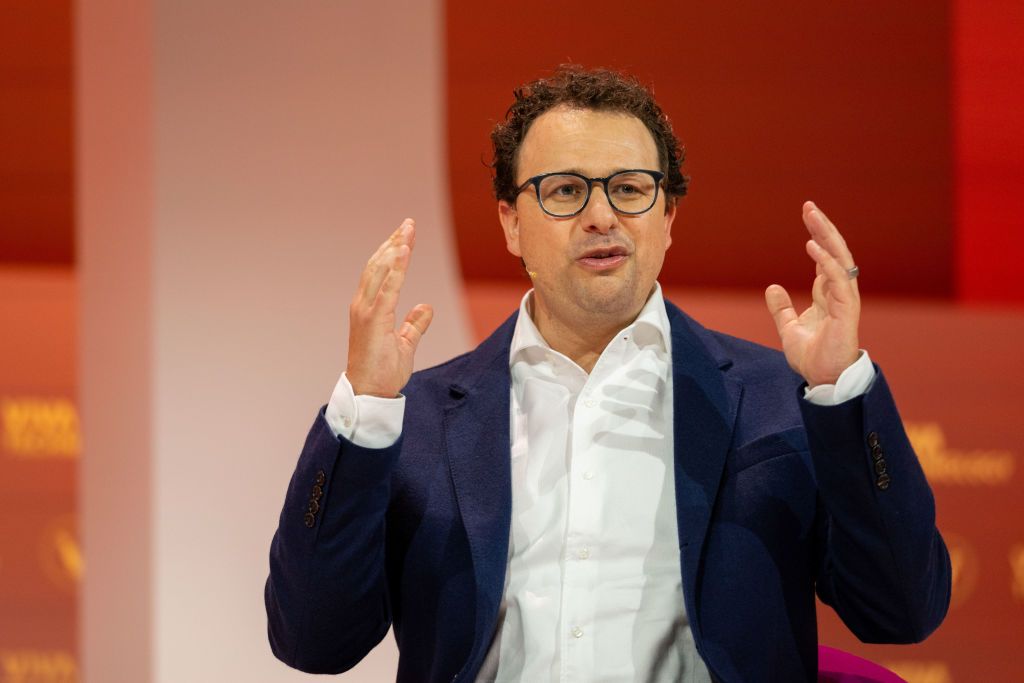
Anthropic CEO Dario Amodei calls rivals' accusations that he favors surrendering human agency to AI 'absurd,' as leading AI firms increasingly automate research and model development.
Executive Takeaways
- Dario Amodei, CEO of Anthropic, has publicly rejected accusations from rivals that he advocates surrendering human control to AI, calling the claims 'absurd.'
- The dispute comes as leading AI companies, including Anthropic, increasingly automate their own research and model development processes.
- The controversy highlights a growing divide in the AI industry over the pace and governance of automation, with safety concerns at the forefront.
- Amodei's response signals a broader debate about human oversight in AI development, with implications for investors, regulators, and the competitive landscape.
The Core Event & Breaking Timeline
In a sharp rebuke to his critics, Anthropic CEO Dario Amodei on Wednesday dismissed accusations from rival AI executives that he favors surrendering human agency to artificial intelligence, calling the claims 'absurd.' The pushback, first reported by TechCrunch, comes amid escalating tensions in the AI industry over how much control humans should retain as companies automate more of their own research and development.
The accusations, which have circulated in private industry forums and surfaced in recent public comments, suggest that Amodei's advocacy for advanced AI systems—and his company's aggressive automation of model training—amounts to a de facto surrender of human oversight. Amodei's response was unequivocal: 'The idea that I or anyone at Anthropic would advocate for surrendering human control is absurd,' he said, according to sources familiar with the matter. 'Our entire mission is built on ensuring AI remains safe and aligned with human values.'
The timeline of the dispute traces back to late 2023, when Anthropic began deploying AI systems to assist in tasks like code generation, data labeling, and even the design of training protocols. Rivals, including some former colleagues from OpenAI, have pointed to these practices as evidence that Anthropic is prioritizing capability over caution. The tension escalated in recent weeks after a series of leaked internal documents suggested that Anthropic's automated research pipeline had reduced human review cycles by up to 40%.
Market reaction was muted but telling. Shares of AI-focused ETFs dipped slightly on the day of Amodei's comments, while Anthropic's private valuation remained stable at approximately $18 billion, according to secondary market data. Investors appear to be weighing the reputational risks of the controversy against Anthropic's strong technical momentum, including its recent Claude 3 model releases.
Deep Technical & Financial Architecture
At the heart of the controversy is Anthropic's use of AI to accelerate its own research. The company has developed a suite of internal tools, collectively known as 'Constitutional AI,' which uses AI models to critique and refine other AI models. This approach, while innovative, reduces the need for human annotators and reviewers, raising questions about the extent of human oversight.
Financially, the automation push is driven by unit economics. Training a state-of-the-art large language model can cost upwards of $100 million, with a significant portion allocated to human labor for data curation and evaluation. By automating these tasks, Anthropic aims to cut costs by 30-50%, according to industry analysts. The company's balance sheet, bolstered by over $7 billion in funding from Google, Spark Capital, and others, gives it room to invest heavily in automation.
However, the technology stack required for such automation is complex. It involves reinforcement learning from AI feedback (RLAIF), where AI models generate their own training data, and automated red-teaming to identify vulnerabilities. While these techniques can improve efficiency, they also introduce new risks, such as model collapse and the amplification of biases. Anthropic has published research on these risks but maintains that its systems include robust human-in-the-loop safeguards.
The financial impact extends beyond Anthropic. Competitors like OpenAI and Google DeepMind are also investing in automation to reduce costs and accelerate development cycles. This industry-wide trend is reshaping the economics of AI, potentially lowering barriers to entry but also concentrating power among a few well-funded players. Venture capitalists are closely watching, with some expressing concern that automation could lead to a 'race to the bottom' on safety.
Industry & Global Market Ripple Effects
The controversy has sent ripples through the AI ecosystem. Competitors have seized on the accusations to position themselves as more committed to human oversight. OpenAI CEO Sam Altman, without directly naming Anthropic, recently emphasized that 'human judgment must remain central' to AI development. Google DeepMind, meanwhile, has highlighted its own 'human-centered' approach, though it too uses automated tools.
Supply chain partners are also affected. Companies that provide data labeling services, such as Scale AI and Labelbox, face potential disruption as AI firms automate more of their annotation needs. Scale AI's CEO, Alexandr Wang, has acknowledged the shift but argues that human expertise will remain essential for complex tasks. Investors are recalibrating their portfolios, with some shifting funds from pure-play AI startups to those with clear human oversight frameworks.
Globally, the debate resonates with regulators. The European Union's AI Act, which is set to be fully implemented by 2026, includes provisions for human oversight in high-risk AI systems. Amodei's comments may be seen as an attempt to align Anthropic with these regulatory expectations. In the US, lawmakers are increasingly scrutinizing automated decision-making, though no federal legislation has yet emerged.
The competitive landscape is also shifting. Anthropic's emphasis on safety has been a key differentiator, attracting enterprise clients in finance and healthcare. If the accusations damage that reputation, it could cede ground to rivals. However, Amodei's forceful denial may reassure customers. Early indicators suggest no major client defections, but the situation remains fluid.
Critical Perspectives, Analyst Debates & Risk Factors
Analysts are divided on the implications. Supporters of Amodei argue that automation is necessary to keep pace with the rapid advancement of AI and that human oversight can be maintained through careful design. 'Anthropic has been a leader in safety research, and their use of AI to improve AI is not inherently risky if properly controlled,' said Sarah Myers West, managing director of the AI Now Institute.
Critics, however, point to the opacity of Anthropic's internal processes. 'The company claims to have human oversight, but the details are vague,' said a former employee who requested anonymity. 'When you automate 40% of your review cycles, you're inevitably reducing human involvement.' This skepticism is echoed by some investors, who worry that safety lapses could lead to regulatory crackdowns or reputational damage.
Risk factors include potential regulatory friction. The US Federal Trade Commission has signaled interest in AI automation, and any perceived lack of human control could trigger investigations. Additionally, the controversy could exacerbate talent wars, with safety-focused researchers gravitating to firms with clearer commitments. Anthropic has already seen some high-profile departures, though it denies they are related.
Another vulnerability is the 'alignment tax'—the cost of ensuring AI systems are safe. If automation reduces costs but compromises safety, the long-term financial impact could be severe. Amodei's challenge is to convince stakeholders that Anthropic can have both efficiency and safety, a balance that remains unproven at scale.
Strategic Forecast & Road Ahead
Over the next 12-24 months, Anthropic is expected to double down on its automation efforts while enhancing transparency. The company plans to publish detailed reports on its human-in-the-loop processes and may introduce third-party audits. These moves aim to rebuild trust and preempt regulatory scrutiny.
Key milestones include the release of Claude 4, which is rumored to incorporate more advanced automation in its training. Anthropic also plans to expand its enterprise offerings, targeting sectors like legal and healthcare where human oversight is critical. Success will depend on convincing clients that automation does not mean abdication of responsibility.
Investors will be watching for signs of financial strain. If automation yields the promised cost savings, Anthropic could improve its margins and attract more funding. However, if safety concerns escalate, the company may face higher insurance premiums and legal costs. The upcoming funding round, expected in late 2024, will be a litmus test.
Ultimately, the debate over human control is far from settled. As AI systems become more capable, the line between assistance and autonomy will blur. Amodei's stance—that human control is non-negotiable—sets a high bar. Whether Anthropic can meet it while staying competitive will define not just the company's future, but the industry's trajectory.



Comments (0)
No comments yet. Be the first to share your thoughts!
Leave a Comment