Maple Raises $5.3M to Build AI That Can't Spy on You
Maple raises $5.3M to develop encrypted AI products that prevent even the company from accessing user data, aiming to solve AI's privacy paradox.
Executive Takeaways
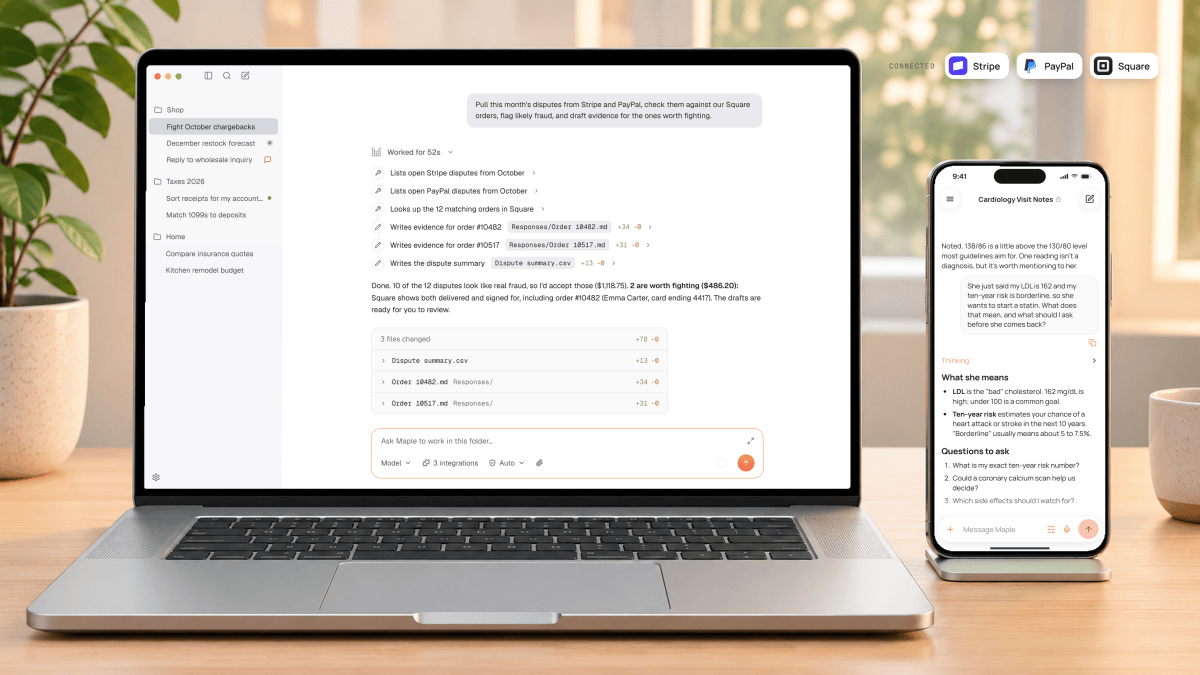
- Maple has raised $5.3 million to build AI products with an encrypted architecture that prevents even the company itself from accessing user data.
- The startup aims to address the growing tension between AI utility and data privacy, a critical barrier to enterprise adoption.
- Maple's approach involves advanced encryption and secure multi-party computation to enable AI processing on encrypted data.
- The funding will accelerate product development and go-to-market strategies, targeting regulated industries like healthcare and finance.
- While promising, the technology faces challenges in performance overhead and complexity, and the market is increasingly crowded with privacy-focused AI solutions.
The Core Event & Breaking Timeline
In a significant development for the intersection of artificial intelligence and data privacy, startup Maple announced on Wednesday that it has secured $5.3 million in seed funding. The round, led by prominent venture capital firms with participation from angel investors, positions Maple to advance its mission of building AI products that are fundamentally designed to protect user data—even from Maple itself. The announcement, first reported by TechCrunch, comes at a time when concerns over data privacy in AI systems are reaching a fever pitch, with high-profile data breaches and regulatory scrutiny intensifying.
Maple's core proposition is an encrypted AI architecture that ensures the company cannot access the private data of its users. This is achieved through a combination of advanced cryptographic techniques, including homomorphic encryption and secure multi-party computation, which allow AI models to process data without ever decrypting it. The company claims that this approach not only enhances privacy but also builds trust with customers who are increasingly wary of handing over sensitive information to AI providers.
The funding round, which closed earlier this month, saw participation from a mix of institutional investors and strategic angels. While the exact valuation was not disclosed, sources close to the deal suggest it was a standard seed round with a post-money valuation in the range of $25-30 million. The capital will be used to expand Maple's engineering team, accelerate product development, and initiate go-to-market efforts targeting enterprise customers in regulated sectors such as healthcare, finance, and legal.
Initial market reaction has been cautiously optimistic. Industry analysts note that while the privacy-preserving AI space is still nascent, the demand for such solutions is growing rapidly. "Enterprises are increasingly looking for AI tools that can assure them their data won't be used or exposed improperly," said one analyst. "Maple's strong privacy guarantees could be a differentiator, but the proof will be in the performance and scalability of their products."
Deep Technical & Financial Architecture
At the heart of Maple's offering is a sophisticated encryption stack that enables AI computations on encrypted data. The company leverages fully homomorphic encryption (FHE), which allows mathematical operations to be performed on ciphertexts, producing an encrypted result that, when decrypted, matches the result of operations performed on the plaintext. This is combined with secure multi-party computation (SMPC) and trusted execution environments (TEEs) to create a layered defense. Maple's architecture ensures that data remains encrypted both at rest and in transit, and even during processing, meaning that neither Maple nor any third party can access the raw data.
From a financial perspective, Maple's model is likely to be subscription-based, with tiered pricing depending on usage and the level of privacy guarantees. The company may also offer usage-based pricing for API calls. While the unit economics of FHE are currently challenging due to computational overhead—often orders of magnitude slower than plaintext operations—Maple's team has developed optimizations that they claim reduce the overhead to a manageable level for many use cases. The seed funding will help them further improve performance and reduce costs.
The technology stack includes a proprietary SDK that allows developers to integrate Maple's privacy-preserving AI capabilities into their applications. The SDK abstracts away the complexities of cryptography, providing simple APIs for common tasks such as text classification, entity recognition, and sentiment analysis. Maple also offers a managed service for customers who prefer a turnkey solution. The company's balance sheet post-funding shows a healthy cash position to sustain operations for at least 18-24 months, with a burn rate estimated at around $200,000 per month.
Maple's approach also includes a novel key management system where encryption keys are split among multiple parties, ensuring that no single entity—including Maple—can decrypt data alone. This is particularly important for compliance with regulations like GDPR and HIPAA, which mandate strict controls over personal data. The company has already filed for several patents related to its encryption techniques and AI model training on encrypted data.
Despite the promise, the financial viability of Maple's model hinges on its ability to attract enterprise customers willing to pay a premium for privacy. The market for privacy-enhancing technologies (PETs) is projected to grow to $20 billion by 2030, according to some estimates, but competition is fierce. Maple's seed funding is a vote of confidence, but the company will need to demonstrate clear ROI for customers to scale.
Industry & Global Market Ripple Effects
Maple's funding and technology come at a time when the AI industry is grappling with a trust deficit. High-profile incidents, such as data leaks from AI chatbots and concerns over model training on copyrighted or personal data, have made privacy a boardroom issue. Maple's encrypted AI could provide a solution for companies that want to leverage AI without risking sensitive data exposure. This is particularly relevant in healthcare, where patient data is highly sensitive, and in finance, where regulations are stringent.
The competitive landscape is heating up. Maple joins a growing list of startups and tech giants working on privacy-preserving AI. Google has been researching federated learning, while Apple emphasizes on-device processing. Other startups like Opaque Systems and Duality Technologies offer secure data analytics platforms. However, Maple's focus on a full-stack AI product with strong encryption from the ground up differentiates it. The company's success could accelerate the adoption of PETs across industries and pressure larger AI providers to enhance their privacy features.
Investors are increasingly bullish on privacy tech. The seed round for Maple was oversubscribed, according to sources, indicating strong appetite for solutions that address regulatory and consumer privacy concerns. This funding could spur more investment in the sector, leading to innovation and consolidation. Maple's technology also has implications for global data flows; by enabling AI processing on encrypted data, it could facilitate cross-border data collaboration while respecting local data sovereignty laws.
Supply chain effects are less direct but still notable. Maple's reliance on advanced cryptography may increase demand for specialized hardware, such as GPUs with cryptographic acceleration or secure enclaves. This could benefit chipmakers like Intel and AMD, which are already integrating security features into their processors. Additionally, Maple's success could drive demand for cloud services that support confidential computing, such as AWS Nitro Enclaves or Azure Confidential Computing.
Critical Perspectives, Analyst Debates & Risk Factors
While Maple's vision is compelling, skeptics question whether the technology can deliver on its promises at scale. Fully homomorphic encryption is notoriously slow, and while Maple claims to have optimized it, independent benchmarks are lacking. Critics argue that the performance overhead may be too high for real-time applications, limiting Maple's addressable market. Furthermore, the complexity of the system could lead to implementation errors that undermine security.
Another concern is the trust model. Maple says it cannot access user data, but users must trust that the encryption is implemented correctly and that there are no backdoors. This requires transparency and third-party audits, which Maple has committed to but not yet completed. Some analysts also point out that the company's key management system, while decentralized, still relies on Maple to coordinate, creating a potential single point of failure.
Regulatory friction is another risk. While Maple's technology could help with compliance, it may also run afoul of law enforcement requests for data access. Governments increasingly demand lawful interception capabilities, and encryption that prevents even the provider from accessing data could put Maple in legal crosshairs. The company will need to navigate these issues carefully, possibly by offering different configurations for different jurisdictions.
On the financial side, the seed round is modest compared to the capital required to scale a deep-tech company. Maple will likely need to raise significantly more in the coming years, and the path to profitability is uncertain. The company faces competition from well-funded incumbents and other startups, and customer acquisition costs in enterprise sales can be high. The bear case is that Maple's technology remains niche, appealing only to a small segment of highly regulated customers.
Strategic Forecast & Road Ahead
In the next 12 months, Maple plans to launch its first product, a privacy-preserving text analysis API, targeting healthcare and financial services. The company will also publish technical whitepapers and undergo security audits to build credibility. By the end of 2025, Maple aims to have 10-15 enterprise customers in production, which would validate its go-to-market strategy and provide case studies for broader adoption.
Looking further ahead, Maple intends to expand its product line to include image and speech processing, and to offer on-premises deployments for customers with strict data residency requirements. The company also plans to develop partnerships with cloud providers and system integrators to reach a wider audience. A Series A funding round is anticipated in late 2025 or early 2026, which will be used to scale sales and marketing and to further R&D.
Key milestones to watch include the performance benchmarks of Maple's API compared to plaintext alternatives, the results of security audits, and the announcement of first paying customers. Additionally, any regulatory approvals or certifications (e.g., HIPAA, GDPR) will be important signals. The company's ability to attract top talent in cryptography and machine learning will also be critical.
Ultimately, Maple's success will depend on whether it can convince enterprises that the trade-off between privacy and performance is worth it. If it can, Maple could become a key player in the burgeoning privacy-preserving AI market, and its technology could set a new standard for how AI systems handle sensitive data. If not, it may remain a niche solution. Either way, its journey will be closely watched as a bellwether for the intersection of AI and privacy.




Comments (0)
No comments yet. Be the first to share your thoughts!
Leave a Comment