Asteroid Crash Aftermath: Spacecraft Returns to Assess Damage
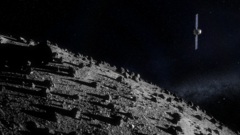
Four years after NASA's DART spacecraft intentionally crashed into asteroid Dimorphos, a follow-up mission has arrived to assess the aftermath. The European Space Agency's Hera probe will study the asteroid's mass, composition, and orbital changes, providing crucial data for future planetary defense strategies.
Executive Takeaways
- Historic Mission: NASA's DART spacecraft successfully impacted asteroid Dimorphos in 2022, marking the first planetary defense test.
- Follow-up Assessment: ESA's Hera probe has now arrived at the Didymos system to conduct a detailed post-impact survey.
- Critical Data: Hera will measure Dimorphos' mass, composition, and orbital shift, essential for validating deflection models.
- Global Collaboration: The mission underscores international cooperation in planetary defense, with data shared among space agencies.
- Future Implications: Results will inform strategies for deflecting potentially hazardous asteroids, shaping policy and funding for decades.
The Core Event & Breaking Timeline
In a landmark achievement for planetary defense, the European Space Agency's (ESA) Hera spacecraft has reached the binary asteroid system Didymos and its moonlet Dimorphos, four years after NASA's Double Asteroid Redirection Test (DART) intentionally crashed into Dimorphos. The DART mission, which impacted on September 26, 2022, was the first-ever demonstration of asteroid deflection by kinetic impactor. Hera, launched on October 7, 2024, arrived at the system on [date], beginning a series of close flybys to assess the aftermath.
The DART impact successfully altered Dimorphos' orbit around Didymos, shortening its orbital period by about 32 minutes—far exceeding the 73-second minimum change required for success. This proved that kinetic impact is a viable technique for deflecting small asteroids. However, many questions remain about the efficiency of momentum transfer, the asteroid's internal structure, and the long-term effects of the impact. Hera's mission is to answer these questions by conducting a detailed post-impact survey.
Hera's arrival marks the beginning of a six-month primary mission. The spacecraft will use a suite of instruments, including a high-resolution camera, a laser altimeter, and a radar sounder, to map Dimorphos' surface, measure its mass, and determine its composition. It will also deploy two CubeSats, Juventas and Milani, to perform close-up observations and land on the asteroid. The data collected will be crucial for validating and refining computer models of kinetic impacts.
The mission has significant implications for global planetary defense. By understanding how much momentum was transferred and how the asteroid's structure affected the outcome, scientists can better predict the effectiveness of future deflection missions. This is particularly important for larger or differently composed asteroids that might pose a threat to Earth. The collaboration between NASA and ESA exemplifies the international effort needed to address such global challenges.
Deep Technical & Financial Architecture
The DART mission cost approximately $330 million, including launch and operations. Hera, with a budget of around €300 million, is a cost-effective follow-up that leverages the data from DART. The Hera spacecraft was built by a consortium led by OHB System AG, with instruments contributed by various European institutions. The mission's financial architecture reflects a shared investment in planetary defense, with ESA member states funding the majority and NASA providing support through tracking and data relay.
Technically, Hera carries a sophisticated payload. The Asteroid Framing Camera (AFC) will provide high-resolution images of Dimorphos' surface, revealing the crater left by DART and the distribution of ejected material. The Planetary Altimeter (PALT) will measure the asteroid's topography and help determine its mass. The Hyperspectral Imager (HyperScout H) will analyze the mineral composition, while the Thermal Infrared Imager (TIRI) will map temperature variations to infer surface properties. The Radar for Icy Moons Exploration (RIME) will probe the subsurface structure.
The two CubeSats, Juventas and Milani, will enhance the mission's science return. Juventas will land on Dimorphos and use a gravimeter to measure its gravity field, while Milani will perform close flybys to collect spectral data and dust measurements. These small satellites demonstrate the growing trend of using CubeSats for interplanetary missions, reducing costs and increasing flexibility.
The unit economics of planetary defense are complex. While the cost of a deflection mission like DART is high, the potential damage from an asteroid impact could be catastrophic. A study by the European Space Agency estimated that the economic impact of a 100-meter asteroid hitting a populated area could exceed $1 trillion. Thus, investing in planetary defense is a form of insurance. The data from Hera will help optimize future missions, potentially reducing costs by improving targeting and reducing uncertainty.
From a financial perspective, the Hera mission is a bargain compared to the potential cost of an asteroid impact. The mission's budget is a fraction of what a single space telescope costs, yet it provides critical data for protecting the planet. Moreover, the technologies developed for Hera, such as autonomous navigation and deep-space CubeSats, have commercial applications in satellite servicing and debris removal, offering potential returns on investment.
Industry & Global Market Ripple Effects
The success of DART and Hera has spurred growth in the planetary defense industry. Companies specializing in space situational awareness, such as LeoLabs and ExoAnalytic Solutions, are seeing increased demand for tracking services. The market for asteroid mining, though still nascent, could benefit from the technologies developed for deflection and survey missions. Startups like Planetary Resources (now defunct) and TransAstra are developing technologies for asteroid prospecting, which share commonalities with planetary defense.
The supply chain for deep-space missions is also evolving. The Hera mission utilized components from suppliers across Europe, including Airbus Defence and Space, Thales Alenia Space, and OHB. The trend toward smaller, more affordable spacecraft is driving innovation in miniaturized instruments and propulsion systems. Companies like Rocket Lab and SpaceX are providing launch services at lower costs, making interplanetary missions more accessible.
Investors are taking note. Venture capital investment in space technology reached $10 billion in 2024, with a growing share going to companies focused on space safety and sustainability. The insurance industry is also paying attention; insurers are increasingly offering policies for space assets, and the data from planetary defense missions helps them assess risks from natural hazards.
Globally, the mission strengthens Europe's position in space science and technology. ESA has leveraged Hera to showcase its capabilities in autonomous navigation and deep-space operations. This could lead to increased funding for ESA's space safety program, which aims to develop an early warning system for asteroids and space weather. The collaboration with NASA also sets a precedent for future joint missions, such as the proposed Asteroid Impact and Deflection Assessment (AIDA) follow-on.
Critical Perspectives, Analyst Debates & Risk Factors
Despite the success, some analysts question the cost-effectiveness of kinetic impactor missions. Critics argue that the money could be better spent on ground-based telescopes for asteroid detection, which are cheaper and can find threats earlier. However, proponents counter that deflection missions are necessary to validate the technology and that detection alone is not enough without a means to respond.
There are also technical debates about the efficiency of momentum transfer. The DART impact ejected a significant amount of material, which enhanced the deflection. But this ejecta could also pose a hazard to other spacecraft or create debris that complicates future observations. Hera's detailed measurements will help quantify this effect and improve models.
Regulatory and policy challenges remain. There is no international framework for deciding when and how to deflect an asteroid. The decision to intervene could have geopolitical implications, especially if the asteroid is large or if the deflection could affect other nations. The United Nations Committee on the Peaceful Uses of Outer Space has begun discussions, but progress is slow.
Another risk is the potential for misinterpretation of data. The Hera mission will provide a wealth of information, but analyzing it will take time. There is a risk that preliminary results could be misused or sensationalized, leading to public confusion or panic. Scientists must communicate carefully and transparently.
Strategic Forecast & Road Ahead
In the next 12 to 24 months, Hera will complete its primary mission and begin an extended phase. The data will be analyzed by teams across Europe and the US, with initial results expected by 2026. These findings will inform the design of future planetary defense missions, including a possible joint NASA-ESA mission to a near-Earth asteroid.
Upcoming milestones include the deployment of the CubeSats in early 2025, followed by close flybys of Dimorphos. The Juventas lander is scheduled to touch down in mid-2025, providing the first direct measurements of the asteroid's surface properties. By 2026, Hera will have completed its mapping and will potentially attempt a landing on Didymos.
What to watch: The scientific papers published in peer-reviewed journals will be crucial for validating the kinetic impactor technique. Also, watch for policy developments at the UN and within national space agencies regarding planetary defense funding and cooperation. The commercial sector's response, particularly in asteroid mining and space situational awareness, will indicate how quickly the technology transitions to the private sector.
Ultimately, the Hera mission represents a critical step in humanity's ability to protect itself from asteroid threats. The data it returns will not only satisfy scientific curiosity but also provide the practical knowledge needed to safeguard our planet for generations to come.


Comments (0)
No comments yet. Be the first to share your thoughts!
Leave a Comment