Giant Catapult to Space: Physics Says Yes, Bodies Say No
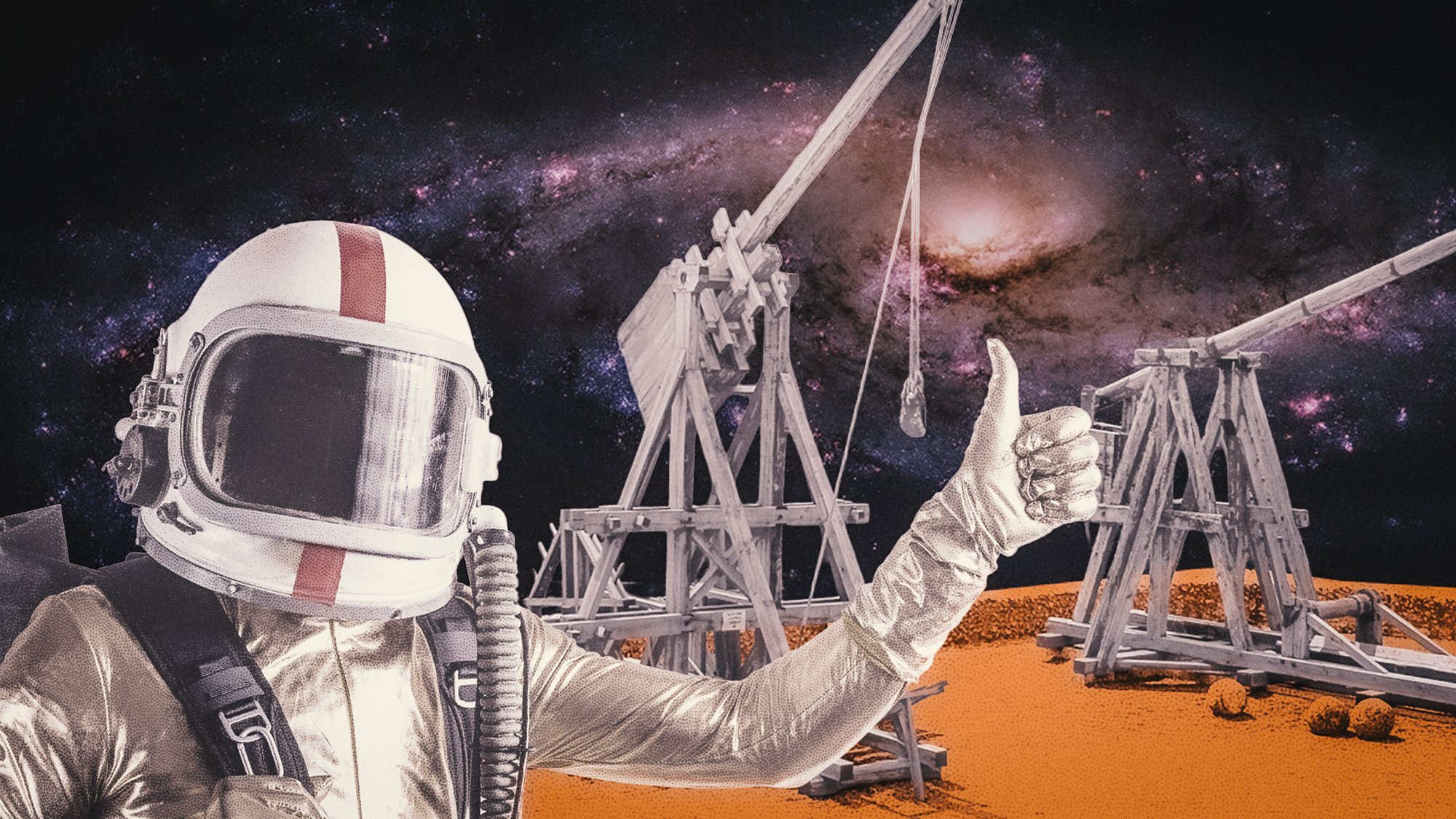
Popular Science confirms a giant catapult could physically launch a person to space, but the human body could not survive the acceleration. The concept revives kinetic launch economics now drawing serious capital.
Executive Takeaways
- The physics is settled: A sufficiently large catapult, centrifuge, or electromagnetic accelerator can impart the roughly 7.8 km/s needed for low Earth orbit — the engineering constraint is energy and materials, not theory.
- The biology is the blocker: Human tolerance caps sustained acceleration at roughly 3–5 g for trained crew and far less for civilians, while kinetic launchers impose hundreds to thousands of g.
- Capital is returning: Kinetic and electromagnetic launch startups have raised hundreds of millions in aggregate, betting on cargo-first economics before any crewed variant.
- The real market is freight: Raw materials, propellant, water, and bulk components — not people — are the plausible payloads for ground-based kinetic launch.
- Watch the next 24 months: Suborbital test cadence, payload mass records, and whether any kinetic launcher secures an anchor customer will determine if this is a durable sector or a physics demo.
Section 1: The Core Event & Breaking Timeline
Popular Science published a deceptively simple question this week — could a giant catapult launch someone to space? — and answered it with an equally simple verdict: yes, physically, but the passenger would not survive the ride. The framing is playful, but the underlying subject is one of the oldest and most consequential debates in aerospace engineering: whether ground-based kinetic launch can ever compete with the chemical rocket as a way to reach orbit.
The dispatch landed in a live news cycle. Kinetic launch is no longer a thought experiment confined to textbooks. Over the past decade, a small cluster of ventures has pursued centrifugal and electromagnetic launch systems, with the most visible being SpinLaunch, which has conducted a series of suborbital test flights from Spaceport America in New Mexico using a vacuum-sealed centrifuge. Those tests have thrown instrumented payloads to tens of thousands of feet, validating the core mechanics while stopping well short of orbital velocity.
The immediate reaction from the space community was a familiar split. Engineers nodded at the physics; physiologists winced at the biology. The acceleration profile of a catapult or centrifuge is measured in hundreds of g, not the single-digit g loads that human spaceflight is designed around. A crewed catapult is therefore not a near-term engineering problem but a fundamental mismatch between machine and organism.
Market reaction was muted, as it should be for a conceptual explainer rather than a corporate announcement. But the piece functions as a useful marker: public curiosity about non-rocket launch is rising in step with launch demand, and the question of whether kinetic systems can carve out a commercial niche is moving from the fringe to the mainstream technology press.
Section 2: Deep Technical & Financial Architecture
The mechanics of a space catapult are straightforward in principle. To reach low Earth orbit, a payload needs a horizontal velocity of roughly 7.8 km/s, plus additional velocity to cover atmospheric drag and gravity losses. A catapult, railgun, or centrifuge delivers that energy from the ground, bypassing the rocket equation's tyranny — the exponential relationship between propellant mass and payload mass that makes chemical launch so expensive.
The energy budget is the first hard constraint. Accelerating a 100 kg payload to 7.8 km/s requires on the order of 3 gigajoules of kinetic energy, before losses. Delivered over a few seconds, that implies gigawatt-scale power draw — feasible only with massive capacitor banks, flywheels, or grid-scale storage, and only at a site with exceptional power infrastructure. The unit economics improve dramatically with scale: doubling payload mass roughly halves cost per kilogram, which is why every credible kinetic launch concept is designed around large, dense, robust payloads.
The materials problem is the second constraint. At orbital velocity in the lower atmosphere, aerodynamic heating and dynamic pressure are brutal. A ground-launched projectile must either punch through the atmosphere quickly with an ablative or heat-resistant shell, or be launched from high altitude — a mountain, a balloon, or an evacuated tube. SpinLaunch's approach of spinning in a vacuum and releasing at altitude is one workaround; electromagnetic sleds on high-altitude terrain are another.
Human physiology is the third and decisive constraint. Sustained acceleration tolerance for trained fighter pilots is roughly 9 g in specialized suits, and comfortable crewed launch profiles stay near 3 g. A catapult delivering orbital velocity over even a generous 100 km of track would impose tens of g; a centrifuge imposes hundreds. The Popular Science verdict — you wouldn't want to be the projectile — is a polite summary of a hard biological wall.
On the financial side, kinetic launch promises a step-change in cost per kilogram if it works at scale. Chemical launch has fallen from roughly $50,000/kg on legacy vehicles to a few thousand dollars per kilogram on reusable rockets, and aspirational targets sit below $1,000/kg. Kinetic advocates argue ground-based systems could eventually undercut even that, because the expensive, reusable hardware stays on the ground. The catch is capital intensity: the infrastructure is bespoke, the development timeline is long, and the addressable payload market — rugged, dense, acceleration-tolerant cargo — is narrower than the headline launch market.
Section 3: Industry & Global Market Ripple Effects
The competitive landscape is dominated by reusable chemical rockets, and any kinetic entrant must justify itself against a moving target. SpaceX's Falcon 9 and Starship, Rocket Lab's Electron and Neutron, and a crowded field of Chinese and European launchers are all driving costs down. Kinetic launch does not need to beat rockets on every mission — only on the subset where its constraints are acceptable.
That subset is meaningful. Bulk water, propellant, raw metals, radiation shielding, and structural feedstock for orbital habitats are all dense, robust, and indifferent to high g. As commercial space stations and lunar programs scale, demand for cheap bulk cargo could grow faster than demand for delicate satellites, creating a genuine niche for kinetic systems.
Supply chains would shift accordingly. Kinetic launch pulls from power electronics, high-strength composites, vacuum systems, and grid-scale energy storage rather than from cryogenic propellant and rocket engine supply chains. That reorients procurement toward industrial suppliers and away from the specialized aerospace propulsion base, with knock-on effects for component makers and materials firms.
Investor interest is real but disciplined. Venture capital in launch has concentrated around proven reusable architectures, and kinetic startups have raised in the hundreds of millions cumulatively rather than the billions commanded by leading rocket companies. Strategic investors — defense agencies, space agencies, and industrial conglomerates — are the more likely early backers, because the technology's dual-use potential in hypersonic testing and high-speed delivery is substantial.
Section 4: Critical Perspectives, Analyst Debates & Risk Factors
Skeptics argue that kinetic launch is a solution in search of a problem. The payloads that tolerate extreme acceleration are cheap and low-value; the payloads that are valuable — satellites, instruments, crew — cannot survive the ride. That leaves a narrow band of cargo, and critics note that rockets are getting cheaper and more reusable faster than kinetic systems are maturing.
Advocates counter that the comparison is unfair because kinetic launch is early-stage. They point to the long history of dismissed launch concepts that later became viable, and to the fact that ground-based systems avoid the operational complexity and weather sensitivity of rocket launches. The debate hinges on whether kinetic launch can reach meaningful cadence and payload mass within a commercially relevant timeframe.
Regulatory and safety friction is significant. A ground-based accelerator throwing payloads at hypersonic speed raises airspace management, debris, and range-safety questions that existing launch licensing frameworks handle awkwardly. Environmental review for gigawatt-scale power infrastructure and high-altitude release corridors adds years to deployment timelines.
The human-factors question remains the sharpest risk. Any crewed variant would require acceleration mitigation — water immersion, g-suits, or staged acceleration over very long tracks — that multiplies cost and complexity. For now, the credible consensus is that kinetic launch is a cargo technology, and any messaging that implies otherwise risks overpromising to investors and the public.
Section 5: Strategic Forecast & Road Ahead
Over the next 12 months, expect kinetic launch companies to focus on payload mass records and test cadence rather than orbital attempts. Suborbital demonstrations that reliably deliver instrumented payloads at increasing velocity are the key milestone, because they validate the release mechanism, thermal protection, and recovery systems that orbital flight depends on.
In the 12–24 month window, the decisive signal will be commercial traction. An anchor customer — a space station operator, a propellant depot developer, or a defense agency — committing to bulk cargo delivery would transform the sector's credibility. Absent that, kinetic launch risks remaining a well-funded demonstration program.
Watch also for adjacent applications. Hypersonic testbeds, high-speed atmospheric delivery, and kinetic energy research all share the core technology and offer nearer-term revenue than orbital launch. Companies that monetize these adjacencies may fund their way to the orbital prize.
The bottom line: the catapult-to-space question has a clear answer — the physics permits it, the biology forbids it for people, and the economics will decide it for cargo. The next two years will reveal whether kinetic launch becomes a genuine pillar of the launch market or a fascinating footnote in the history of getting off the planet.




Comments (0)
No comments yet. Be the first to share your thoughts!
Leave a Comment