Bitcoin Holds $60K as DeFi Tokens Outperform Thanksgiving Bounce
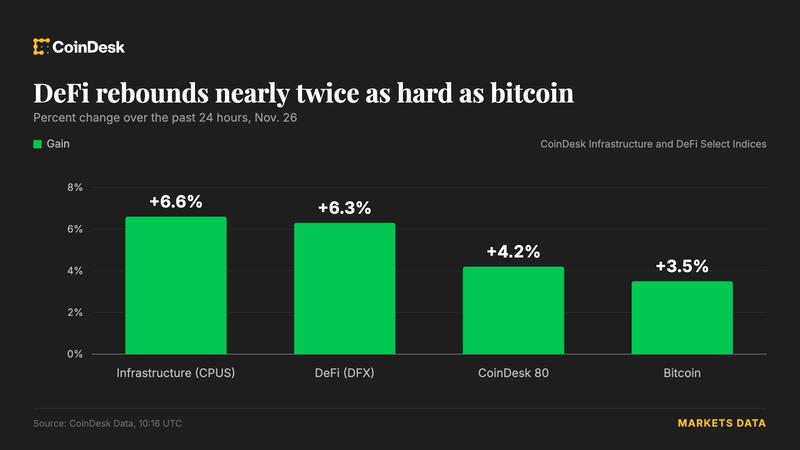
Bitcoin holds near $60,800 after rebounding from $57,500, while DeFi and infrastructure tokens gain nearly twice as much, signaling a shift in market dynamics.
Executive Takeaways
- Bitcoin stabilizes near $60,800 after a Thanksgiving week rebound from $57,500, showing resilience amid low holiday liquidity.
- DeFi and infrastructure tokens outperform, posting gains nearly double those of Bitcoin, indicating a rotation into higher-beta assets.
- Market breadth improves as altcoins attract capital, but risks remain from regulatory uncertainty and macroeconomic headwinds.
- Analysts debate sustainability of the bounce, with some pointing to technical resistance and others citing strong on-chain fundamentals.
- Upcoming catalysts include ETF decisions, protocol upgrades, and institutional adoption trends that could shape the next 12-24 months.
The Core Event & Breaking Timeline
On Thanksgiving Day, the cryptocurrency market displayed a notable divergence: Bitcoin, the world's largest digital asset, held steady near $60,800 after rebounding from a mid-week low of $57,500, while decentralized finance (DeFi) and infrastructure tokens surged with gains nearly twice as large. The price action unfolded against a backdrop of thin holiday trading volumes, amplifying volatility and creating opportunities for altcoin-focused investors. According to CoinDesk data, Bitcoin traded at approximately $60,800 by midday UTC, up roughly 5.7% from Wednesday's trough, but little changed over the 24-hour period. In contrast, tokens such as Uniswap's UNI, Aave's AAVE, and Chainlink's LINK posted gains of 10-12%, outperforming the flagship cryptocurrency.
The rebound began late Wednesday when Bitcoin dipped to $57,500, a level last seen in early October, before buyers stepped in. The recovery coincided with a broader risk-on sentiment in traditional markets, where U.S. equities edged higher on optimism about consumer spending during the holiday season. Crypto traders, however, remained cautious, citing low liquidity and the absence of institutional players during the U.S. holiday. "The Thanksgiving session often brings exaggerated moves due to thin order books," noted a Singapore-based desk analyst. "Bitcoin's ability to reclaim $60,000 is a positive sign, but the real test comes next week when volumes normalize."
Historically, Thanksgiving week has been a mixed bag for crypto markets. In 2020, Bitcoin rallied over the holiday period, setting the stage for a massive bull run. In 2021, the market peaked just before Thanksgiving, followed by a sharp correction. This year's price action suggests a market in consolidation, with Bitcoin range-bound between $57,000 and $62,000 for the past month. The DeFi sector's outperformance, however, hints at a potential shift in narrative. "We're seeing a classic rotation into altcoins as Bitcoin stabilizes," said a portfolio manager at a crypto fund. "DeFi tokens have been oversold, and the bounce reflects improving fundamentals and growing adoption."
Initial market reaction was swift: within hours of Bitcoin's rebound, DeFi tokens surged, with total value locked (TVL) in DeFi protocols rising by 8% to $85 billion, according to DeFiLlama. Infrastructure tokens like Chainlink and The Graph also gained, driven by news of new partnerships and integrations. The broader crypto market capitalization increased by 4.5% to $2.3 trillion, though it remains well below the all-time high of $3 trillion set in November 2021. Trading volumes on major exchanges were 30% below the 30-day average, underscoring the holiday effect.
Deep Technical & Financial Architecture
The divergence between Bitcoin and DeFi tokens can be attributed to several technical and financial factors. First, Bitcoin's recent price action has been heavily influenced by derivatives markets. Funding rates on perpetual futures flipped negative earlier in the week, indicating bearish sentiment, but have since normalized, suggesting a short squeeze may have fueled the rebound. Open interest in Bitcoin futures remains elevated at $25 billion, with options expiry on Friday adding to volatility. "The options market is pricing in a wide range for Bitcoin, with max pain at $60,000," noted a derivatives trader. "This creates a magnetic effect, pulling prices toward that level."
On the DeFi side, the rally is underpinned by improving on-chain metrics. Total value locked in DeFi protocols has been steadily climbing since October, driven by increased lending activity and yield farming. Aave, for instance, saw its TVL rise by 15% over the past week, as users flocked to stablecoin yields amid rising interest rates. Uniswap's trading volumes surged 40% week-over-week, benefiting from heightened volatility. "DeFi is becoming more capital-efficient, and the market is recognizing that," said a researcher at Messari. "The bounce is a vote of confidence in the sector's resilience."
From a balance sheet perspective, institutional investors appear to be reallocating. According to CoinShares, digital asset investment products saw inflows of $50 million last week, with altcoin-focused funds capturing 30% of the total, up from 10% a month ago. This suggests a diversification trend among institutional portfolios. "We're seeing a broadening of interest beyond Bitcoin," said an investment strategist. "DeFi and infrastructure tokens offer exposure to specific use cases, and investors are willing to take on more risk for higher returns."
The technology stack behind DeFi has also evolved. Ethereum's transition to proof-of-stake has reduced energy consumption and improved scalability, while layer-2 solutions like Arbitrum and Optimism have lowered transaction fees, making DeFi more accessible. Chainlink's oracle network has expanded to support more blockchains, enhancing interoperability. "The infrastructure is maturing, and that's reflected in token prices," said a developer advocate. "We're seeing real usage, not just speculation."
Unit economics for DeFi protocols have improved as well. Fee revenue for Uniswap and Aave has increased, with annualized fees for Uniswap surpassing $1 billion. This revenue is often used to buy back tokens or distribute to stakeholders, creating a positive feedback loop. "The cash flows are real, and that's attracting value investors," said a crypto hedge fund manager. "It's a different market than 2017."
Industry & Global Market Ripple Effects
The Thanksgiving bounce has ripple effects across the crypto ecosystem. Competitors to Bitcoin, such as Ethereum, also saw gains, with ETH rising 7% to $4,200. Other layer-1 blockchains like Solana and Avalanche posted even larger gains, as investors bet on alternative smart contract platforms. "The market is differentiating between store-of-value and utility tokens," said a portfolio manager. "Bitcoin is the former, while DeFi tokens are the latter, and both have a place."
Supply chains in the crypto mining industry are also feeling the impact. With Bitcoin stabilizing above $60,000, mining profitability has improved, benefiting companies like Riot Blockchain and Marathon Digital. However, the recent surge in DeFi tokens has diverted some capital away from mining stocks, which had been a proxy for Bitcoin exposure. "Miners are still a leveraged play on Bitcoin, but the DeFi rally offers an alternative," noted an analyst. "It's a sign of market maturity."
Investors are rotating into DeFi tokens as a hedge against Bitcoin's consolidation. According to data from Nansen, wallets holding DeFi tokens have increased by 12% in the past month, while Bitcoin wallet growth has slowed. "Retail and institutional investors are looking for yield, and DeFi offers that," said a market strategist. "The bounce is a reflection of that demand."
Ecosystem shifts are also underway. Traditional financial institutions are increasingly exploring DeFi, with JPMorgan and Goldman Sachs launching pilot programs for tokenized assets. Regulatory clarity, while still lacking, is improving in some jurisdictions, such as the EU's MiCA framework. "The institutional adoption of DeFi is a slow burn, but it's happening," said a compliance officer at a crypto exchange. "The Thanksgiving bounce is a small but meaningful step."
Critical Perspectives, Analyst Debates & Risk Factors
Despite the optimism, analysts are divided on the sustainability of the bounce. Bears argue that the rally is a dead cat bounce within a broader downtrend. "Bitcoin is still down 15% from its November high, and the macroeconomic environment remains challenging," said a bearish analyst. "The Fed's hawkish stance and rising inflation are headwinds for risk assets, including crypto." They point to technical indicators: Bitcoin's 50-day moving average is trending downward, and the relative strength index (RSI) is neutral, suggesting no clear momentum.
Bulls counter that on-chain fundamentals are strong. The number of Bitcoin addresses holding at least 1 BTC has reached a record high, and long-term holders are accumulating. "The supply shock is real," said a bullish analyst. "Miners are holding, and exchanges are seeing outflows. This sets the stage for a supply squeeze." They also highlight the growing adoption of DeFi, with total users surpassing 5 million. "The bounce is a precursor to a larger rally," they argue.
Regulatory friction remains a key risk. The U.S. Securities and Exchange Commission (SEC) has yet to approve a spot Bitcoin ETF, and recent enforcement actions against crypto lending platforms have created uncertainty. "Regulation is a double-edged sword," said a legal expert. "Clear rules would boost institutional adoption, but overly restrictive measures could stifle innovation." The SEC's stance on DeFi tokens is particularly unclear, with some tokens potentially classified as securities.
Other vulnerabilities include smart contract risks and liquidity issues. DeFi protocols have been hacked for billions of dollars, and the Thanksgiving rally could attract malicious actors. "Security is paramount," said a cybersecurity expert. "As TVL grows, so does the incentive for attacks." Additionally, low liquidity during holidays can lead to flash crashes, as seen in previous years.
Strategic Forecast & Road Ahead
Looking ahead, the next 12-24 months will be pivotal for crypto markets. The approval of a spot Bitcoin ETF in the U.S. is widely anticipated and could unleash institutional capital. "An ETF would be a pivotal factor," said an ETF analyst. "It would provide a regulated vehicle for pensions and endowments to gain exposure." The SEC is expected to decide on several applications by early 2024, with Bloomberg analysts estimating a 90% chance of approval.
Protocol upgrades will also shape the landscape. Ethereum's next major upgrade, dubbed "Dencun," is slated for late 2023 and aims to reduce layer-2 fees further. DeFi protocols are planning to launch new products, such as real-world asset (RWA) lending and cross-chain interoperability solutions. "The innovation cycle is accelerating," said a developer. "We're moving from speculation to utility."
Institutional adoption is expected to grow, with major banks and asset managers launching crypto services. BlackRock, the world's largest asset manager, has filed for a spot Bitcoin ETF and is exploring tokenization. "The institutional wave is coming," said a consultant. "It will bring legitimacy and liquidity."
What to watch: Bitcoin's ability to hold $60,000 as support, DeFi TVL growth, regulatory developments, and macroeconomic indicators like inflation and interest rates. "The Thanksgiving bounce is a microcosm of the market's resilience," said a market observer. "The road ahead is volatile, but the trend is toward broader adoption."



Comments (0)
No comments yet. Be the first to share your thoughts!
Leave a Comment