Russian Cargo Ship Sparta II Towed Home After Drone Strike
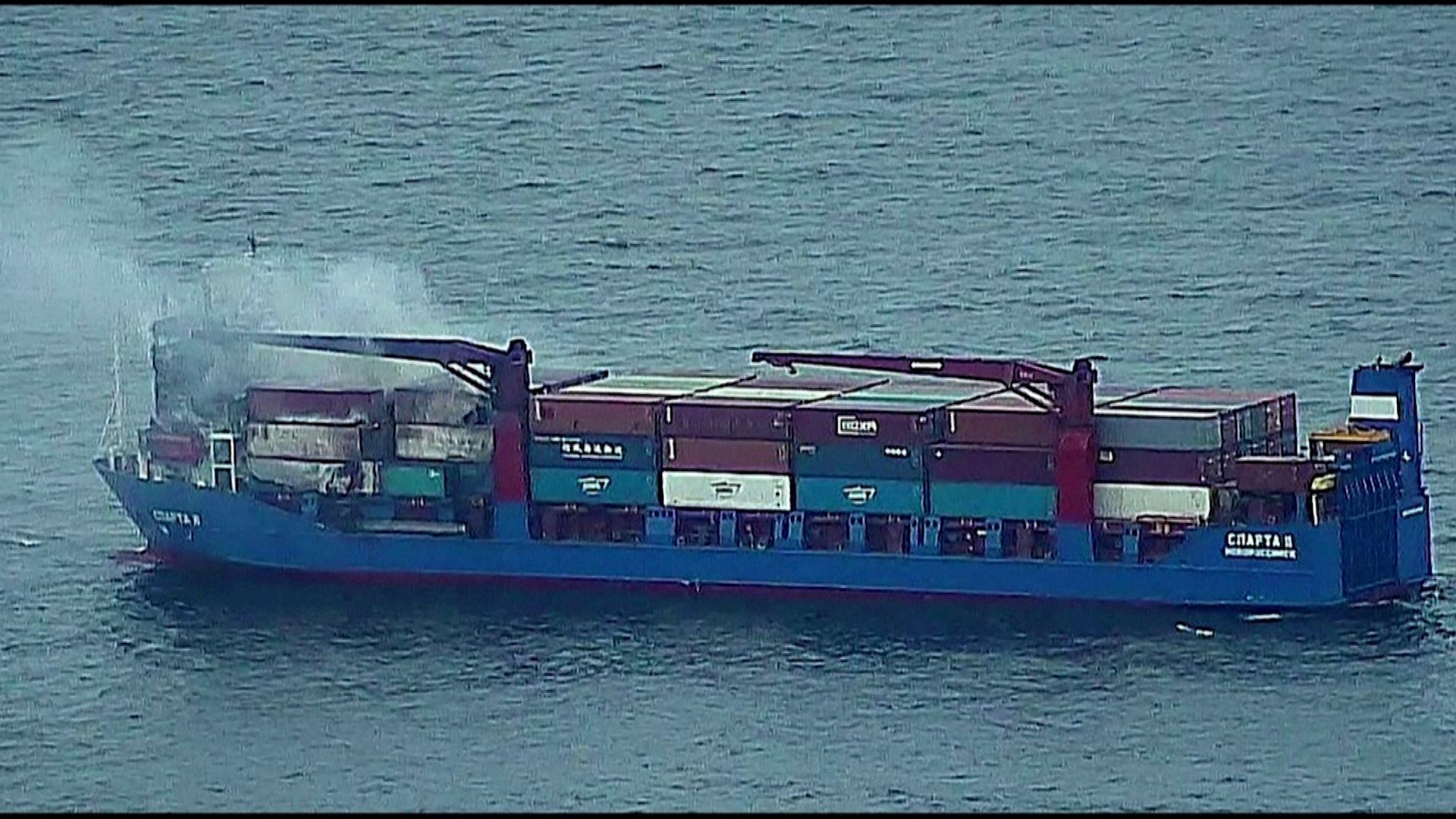
Russian cargo ship Sparta II was towed back to home waters after a Ukrainian drone attack in the Gulf of Finland, spotlighting the rising use of unmanned systems against commercial shipping.
Executive Takeaways
- The Russian cargo vessel Sparta II was towed back to home waters after a Ukrainian drone attack in the Gulf of Finland, marking one of the most northerly maritime drone strikes of the conflict.
- The incident underscores the rapid proliferation of low-cost unmanned surface and aerial systems as force multipliers against conventional naval and commercial assets.
- Maritime insurers, Baltic shipping operators and port authorities now face a materially altered risk calculus across one of Europe's busiest trade corridors.
- The attack signals a shift from symbolic strikes to sustained disruption of logistics, with knock-on effects for energy, grain and container supply chains.
- Defense technologists are racing to field counter-drone systems, creating a fast-growing market segment for detection, jamming and kinetic interception.
Section 1: The Core Event & Breaking Timeline
The Russian cargo ship Sparta II was towed back to home waters after a Ukrainian drone attack in the Gulf of Finland, according to a breaking dispatch from Al Jazeera. The vessel, a general-cargo and ro-ro capable ship operating under the Russian flag, was reportedly struck while transiting the eastern reaches of the Gulf of Finland, a narrow and strategically vital waterway that funnels Russian trade through the Baltic Sea toward St. Petersburg and Ust-Luga. The decision to tow the ship rather than allow it to proceed under its own power suggests damage to propulsion, steering or hull integrity significant enough to render the vessel non-self-propelled.
The timeline, as reconstructed from the dispatch and open-source maritime tracking patterns, points to a drone engagement followed by a coordinated recovery operation. Ukrainian forces have progressively extended the reach of their unmanned systems from the Black Sea into the Baltic theater, and the Gulf of Finland represents the northernmost edge of that expansion. The attack did not immediately produce confirmed casualty figures or a detailed damage assessment, and Russian authorities have historically been reticent to disclose the operational status of vessels struck in contested waters.
Initial market reaction was muted but directional. Baltic dry and general-cargo freight rates showed modest upward pressure as traders priced in elevated war-risk premiums for voyages touching Russian ports. Marine insurers active in the Nordic and Baltic markets began reassessing exposure to Russian-flagged tonnage, a segment already constrained by sanctions compliance regimes. Port agents in the region reported heightened scrutiny of vessel manifests and routing declarations.
The broader significance lies in geography. The Gulf of Finland is a constrained, shallow and heavily monitored waterway bordered by Finland, Estonia and Russia. That a drone could penetrate and strike a cargo vessel there demonstrates a meaningful evolution in the range, guidance and survivability of unmanned systems. It also compresses the reaction time available to naval escorts and port security forces, forcing a rethink of how commercial shipping is protected in confined littoral environments.
Section 2: Deep Technical & Financial Architecture
The technical mechanics of the Sparta II attack fit a now-familiar pattern in modern asymmetric maritime warfare: low-cost unmanned surface vessels (USVs) or long-range one-way attack drones, guided by satellite navigation and electro-optical terminal seekers, closing on a slow-moving, lightly defended commercial target. These systems typically cost between tens of thousands and a few hundred thousand dollars per unit, compared with the multi-million-dollar value of a cargo ship and its payload. That cost asymmetry is the core economic engine of the drone campaign.
From a balance-sheet perspective, the direct loss to the vessel operator is only part of the equation. Hull damage, towage, salvage, port downtime and cargo delay claims compound rapidly. A single towage operation across the Baltic can run into six figures, while a prolonged repair period removes a vessel from revenue service for weeks or months. For operators running thin margins on general cargo, the insurance and operational math can quickly turn a survivable strike into a financially destabilizing event.
The technology stack underpinning such attacks combines commercial satellite communications, GNSS guidance with inertial backup, and increasingly autonomous terminal-phase targeting that reduces dependence on continuous human control. Counter-drone defenses, by contrast, remain fragmented: radar detection in cluttered littoral environments is difficult, electronic warfare jamming can be defeated by frequency-hopping or inertial navigation, and kinetic interception is expensive relative to the threat.
Unit economics favor the attacker decisively. A defending naval escort vessel may cost tens of thousands of dollars per day to operate, while a swarm of inexpensive drones can be launched for a fraction of that sum. This inversion is driving investment toward cheaper, attritable counter-systems — net barriers, automated gun mounts, directed-energy prototypes and AI-enabled detection networks — that can be deployed at scale around high-value ports and chokepoints.
For insurers, the architecture of risk is being rewritten. War-risk clauses, previously calibrated to conventional naval conflict, must now account for persistent, low-signature drone threats across peacetime commercial routes. Underwriters are modeling frequency and severity distributions that include repeated small strikes rather than rare catastrophic events, a shift that raises baseline premiums across entire corridors.
Section 3: Industry & Global Market Ripple Effects
The immediate industry ripple effect is felt across Baltic and Nordic shipping. Operators routing through the Gulf of Finland must weigh war-risk surcharges, rerouting costs and crew safety against contractual obligations. Charterers are increasingly inserting drone-threat clauses into voyage agreements, and some are demanding escorts or convoy scheduling that mirrors Black Sea practices developed over the past two years.
Supply chains tied to Russian exports — including fertilizers, metals, timber and energy products — face renewed friction. While sanctions have already reshaped trade flows, the physical security of vessels adds a new layer of uncertainty. Buyers and intermediaries must price in the possibility of delay, diversion or total loss, and logistics providers are revisiting contingency routing through alternative Baltic and Nordic ports.
The defense technology ecosystem is a clear beneficiary. Counter-drone startups, maritime surveillance firms and autonomous patrol vendors are seeing accelerated procurement interest from navies and port authorities. NATO's Baltic Sentry-style monitoring initiatives and national coast guard modernization programs are expanding budgets for detection and interception, creating a durable demand signal for the sector.
Investors are watching the intersection of shipping, insurance and defense tech closely. Publicly traded defense primes with naval and counter-UAS exposure have drawn renewed attention, while private markets are channeling capital into attritable autonomous systems. The broader lesson for global markets is that geopolitical risk is increasingly expressed through physical infrastructure attacks, which transmit quickly into insurance, freight and commodity pricing.
Section 4: Critical Perspectives, Analyst Debates & Risk Factors
Analysts are divided on the strategic significance of the Sparta II strike. One camp argues that attacks on commercial shipping in the Baltic represent a meaningful escalation that could draw NATO into a more direct protective role, raising the risk of miscalculation. The opposing view holds that such strikes are largely symbolic, demonstrating reach without materially degrading Russian logistics, and that the economic impact remains contained.
There are also questions about attribution and verification. Conflicting claims, limited independent access to the vessel and the fog of wartime information mean that damage assessments should be treated cautiously. Analysts caution against over-reading single incidents, while acknowledging that a pattern of strikes across multiple theaters is harder to dismiss.
Regulatory and legal friction is another risk factor. Attacks on commercial vessels raise complex questions under the law of armed conflict and maritime law, particularly regarding neutral-flag shipping and the safety of civilian crews. Insurers and flag registries are navigating ambiguous liability frameworks, and any incident involving third-country nationals could trigger diplomatic and legal complications.
Operationally, the key vulnerability is escalation management. If drone attacks on shipping become routine, the response could include expanded naval patrols, convoy systems and potentially more aggressive counter-drone rules of engagement. Each of these steps carries its own risk of inadvertent confrontation, making the Baltic a laboratory for how the world manages persistent unmanned threats to global trade.
Section 5: Strategic Forecast & Road Ahead
Over the next 12 to 24 months, expect the Gulf of Finland and broader Baltic corridor to become a focal point for counter-drone investment. Port authorities in Finland, Estonia and neighboring states are likely to accelerate deployment of detection networks, automated interception systems and hardened perimeter defenses around critical infrastructure and anchorage areas.
On the technology side, the market will push toward integrated maritime domain awareness platforms that fuse radar, optical, acoustic and RF data with AI-driven threat classification. Vendors that can deliver affordable, scalable and interoperable systems will capture procurement budgets, while legacy naval suppliers will be pressured to adapt quickly.
For shipping and insurance, the roadmap points to standardized war-risk and drone-threat clauses, revised routing protocols and greater use of convoy and escort arrangements. Freight rates on Baltic routes may carry a persistent risk premium, and operators will increasingly factor security into vessel design, including hardened bridges and redundant propulsion.
What to watch: the pace of counter-UAS procurement announcements, changes in Baltic war-risk premiums, any expansion of naval escort operations, and whether drone strikes on commercial shipping become a sustained campaign or remain episodic. Each data point will shape how markets price the new era of unmanned maritime risk.




Comments (0)
No comments yet. Be the first to share your thoughts!
Leave a Comment