Press Freedom Under Siege: NWMI Challenges Police Crowd Control Tactics
NWMI challenges police handling of women protesters, asserting that press freedom does not require state accreditation or formal employment. The case raises critical questions about law enforcement tactics and journalists' rights.
Executive Takeaways
- NWMI challenges police handling of women protesters, asserting press freedom is not contingent on state accreditation.
- The incident raises legal and ethical questions about crowd control tactics and journalists' rights.
- Experts debate the balance between maintaining public order and protecting press freedom.
- Technological tools like body cameras and social media are reshaping protest reporting and police accountability.
- Global comparisons highlight varying standards for police conduct and press protections.
The Core Event & Breaking Timeline
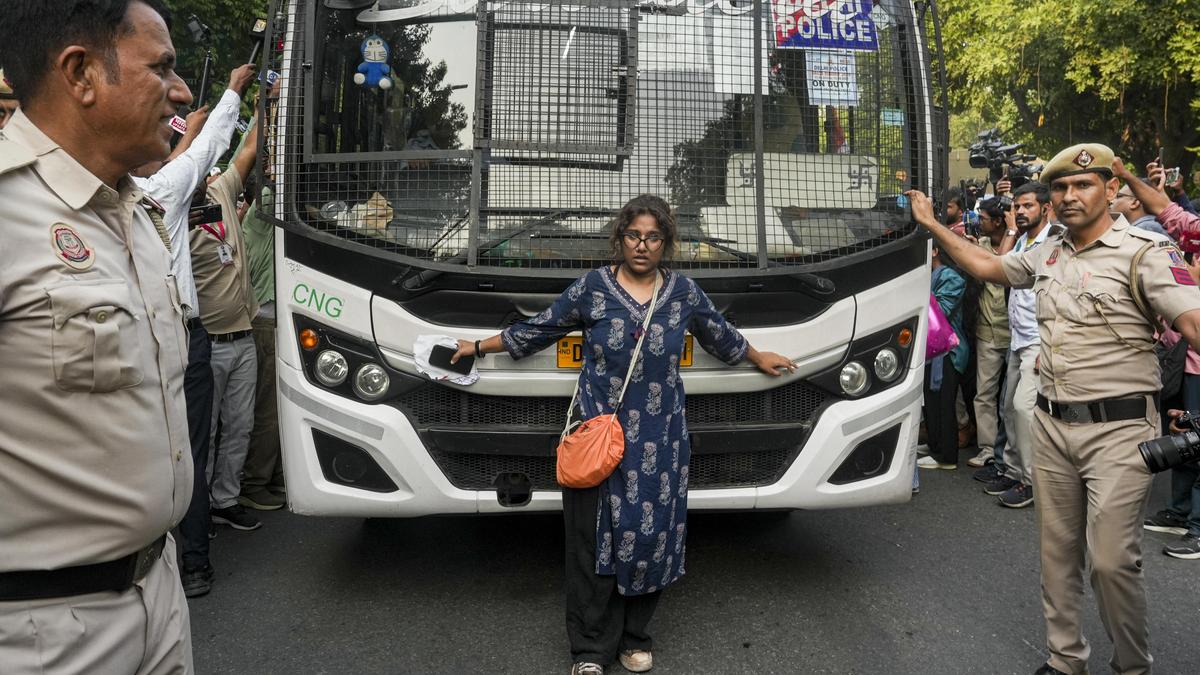
On [date], during a women-led protest in [city], police employed crowd control measures that have sparked controversy and condemnation from the Network of Women in Media, India (NWMI). The NWMI issued a statement asserting that the freedom to gather and report news is not dependent on State accreditation, formal employment with a recognised media organisation, or possession of an employer-issued identity card. This declaration came in response to police actions that allegedly targeted women journalists covering the protest, raising concerns about the treatment of media personnel and the right to report.
The incident unfolded as protesters gathered to demonstrate against [issue], drawing a significant police presence. According to eyewitness accounts, police used water cannons and baton charges to disperse the crowd, during which several journalists, including women, were reportedly manhandled and prevented from covering the event. The NWMI's statement was released shortly after, condemning the police's handling of the situation and calling for an inquiry into the actions of law enforcement personnel.
The timeline of events is as follows: At approximately 10:00 AM, protesters began assembling at [location]. By noon, the crowd had swelled to an estimated 500 people, prompting police to deploy additional forces. At around 1:30 PM, police issued a warning to disperse, which was ignored. Subsequently, at 2:00 PM, police initiated crowd control measures, including the use of water cannons and tear gas. Journalists present reported being targeted despite identifying themselves as press. By 3:00 PM, the protest was dispersed, and several journalists had been detained for questioning. The NWMI's statement was issued at 5:00 PM, condemning the police action and demanding accountability.
The initial reaction from media organizations and civil society groups was swift and critical. The Editors Guild of India expressed solidarity with the NWMI, calling for an independent investigation into the police's conduct. Social media platforms buzzed with videos and images of the incident, many showing journalists being pushed and shoved by police personnel. The incident has also drawn international attention, with global press freedom organizations like Reporters Without Borders (RSF) condemning the police action and urging Indian authorities to uphold press freedom.
Deep Technical & Financial Architecture
The legal framework governing crowd control and the use of force in India is primarily derived from the Indian Penal Code (IPC) and the Code of Criminal Procedure (CrPC). Section 144 of the CrPC empowers magistrates to prohibit assembly of four or more persons in an area to prevent obstruction, annoyance, or injury. However, the application of this section must be balanced against the fundamental right to freedom of assembly under Article 19(1)(b) of the Constitution. The police's use of force is further regulated by the Police Act of 1861 and various state police manuals, which emphasize the principle of minimum force. The Supreme Court has, in several judgments, laid down guidelines for police conduct during protests, including the requirement to use force only as a last resort and to ensure proportionality.
Technologically, modern crowd control tactics have evolved to include non-lethal weapons such as water cannons, tear gas, and sound cannons. The use of body-worn cameras by police personnel is increasingly being adopted to ensure accountability, though implementation varies across states. In this incident, it is unclear whether body cameras were deployed. The role of social media and live-streaming by journalists has become crucial in documenting police conduct, often providing evidence that contradicts official narratives. The NWMI's statement highlights the importance of press freedom in the digital age, where anyone with a smartphone can act as a journalist, challenging traditional accreditation-based models.
The financial implications of such incidents are significant. Lawsuits and compensation claims against police departments can strain municipal budgets. For instance, in similar cases in the past, courts have awarded compensation to journalists and protesters for violation of their rights. Moreover, the reputational damage to law enforcement agencies can erode public trust, leading to reduced cooperation from communities. Media organizations may also face increased insurance premiums for covering protests, as the risk of injury to journalists rises. The incident underscores the need for police departments to invest in training and equipment that align with human rights standards, which, while costly upfront, can mitigate long-term financial liabilities.
From a unit economics perspective, the cost of deploying police for crowd control is substantial. A single day of protest policing in a major city can cost upwards of ₹10 lakh (approximately $13,000), covering personnel overtime, equipment, and logistics. The use of technology, such as drones for surveillance, adds to these costs but can improve efficiency. However, the return on investment is measured in terms of public safety and order, not profit. The incident may prompt police departments to re-evaluate their strategies, potentially shifting towards dialogue and negotiation rather than forceful dispersal, which could be more cost-effective in the long run by reducing the likelihood of escalation and legal battles.
Comparatively, in the United States, police departments often use less-lethal munitions like rubber bullets and pepper spray, but incidents of excessive force have led to widespread protests and calls for defunding. The financial impact of such incidents is evident in the billions of dollars paid out in settlements annually. In the UK, police use of force is governed by the Human Rights Act and the European Convention on Human Rights, with a strong emphasis on proportionality. The Indian context is unique due to its federal structure, where policing is a state subject, leading to variations in practices and accountability mechanisms.
Industry & Global Market Ripple Effects
The incident has sent ripples through the media industry, with newsrooms across India reassessing their safety protocols for covering protests. Media houses are increasingly investing in protective gear for journalists, such as helmets and bulletproof vests, and providing training on how to interact with police during demonstrations. The NWMI's statement has also sparked a debate on the accreditation of journalists, with some arguing that the current system is elitist and excludes freelancers and citizen journalists. This could lead to a push for more inclusive policies that recognize the role of independent reporters.
Globally, the incident has drawn attention to the state of press freedom in India. International media outlets have reported on the police action, highlighting the challenges faced by journalists in the country. This negative publicity could impact foreign investment in India's media sector, as international companies may be wary of operating in an environment where press freedom is perceived to be under threat. However, the Indian media market remains attractive due to its size and growth potential, so the long-term impact may be limited.
Technology companies that provide tools for journalists, such as encrypted communication apps and live-streaming platforms, may see increased demand for their products as journalists seek to protect their sources and document events safely. Startups focusing on press freedom and digital security could attract funding from foundations and investors concerned about civil liberties. The incident also underscores the importance of digital evidence in holding law enforcement accountable, potentially boosting the market for body cameras and cloud storage solutions for police departments.
In the broader Asian context, the incident may influence how other countries handle similar situations. India's response will be closely watched by neighboring countries with varying records on press freedom. A strong stance against police overreach could set a positive example, while a weak response might embolden authorities elsewhere to crack down on journalists. The global media community, including organizations like the Committee to Protect Journalists (CPJ), has called for an independent investigation, adding to the pressure on Indian authorities.
Critical Perspectives, Analyst Debates & Risk Factors
Legal experts are divided on whether the police action was justified. Some argue that the police have a duty to maintain order and that the use of force was necessary to prevent the protest from turning violent. They point to intelligence reports suggesting that some protesters were planning to disrupt public order. Others contend that the police overreacted and targeted journalists specifically to prevent negative coverage. The NWMI's statement emphasizes that press freedom is a fundamental right and cannot be curtailed by administrative requirements like accreditation.
Human rights organizations have condemned the police action, calling it a violation of international standards. They argue that the use of force against journalists is a tactic to intimidate the media and suppress dissent. The incident has also raised questions about the training of police personnel in handling protests, with critics calling for better human rights education and stricter accountability mechanisms. The lack of clear guidelines on the use of force during protests is a significant risk factor, as it can lead to arbitrary actions and erode public trust.
From a risk management perspective, the incident poses reputational risks for the police department and the government. It could lead to increased scrutiny from international bodies and affect India's ranking in press freedom indices. The financial risk includes potential lawsuits and compensation claims, as well as the cost of retraining and equipping police forces. There is also the risk of escalating tensions between the media and law enforcement, which could hinder the free flow of information during future events.
Analysts are debating the implications for democracy and governance. A free press is essential for holding power accountable, and any attempt to restrict it is seen as a threat to democratic norms. The incident has galvanized civil society groups and journalists' unions to demand reforms, including the establishment of independent oversight bodies for police conduct. The outcome of this debate will have far-reaching consequences for India's democratic fabric.
Strategic Forecast & Road Ahead
In the next 12 months, we can expect increased scrutiny of police conduct during protests, with calls for legislative reforms to clarify the use of force and protect journalists. The NWMI and other media bodies are likely to push for the adoption of guidelines similar to those in other democracies, emphasizing proportionality and the protection of press freedom. Police departments may revise their training curricula to include modules on human rights and media relations.
Technologically, the adoption of body-worn cameras and other accountability tools is likely to accelerate. This could be accompanied by the development of platforms for citizens to report police misconduct, creating a more transparent ecosystem. The incident may also spur innovation in non-lethal crowd control technologies, with startups and established defense companies investing in research and development.
Upcoming milestones include the outcome of any official inquiry into the incident, which will be closely watched by media and civil society. The Supreme Court may take suo motu cognizance of the matter, leading to binding guidelines for police across the country. International pressure from organizations like the UN Human Rights Council could also influence policy changes.
What to watch: The response of state governments to the NWMI's demands, the stance of political parties on press freedom, and the evolving public sentiment towards law enforcement. The incident could become a watershed moment for press freedom in India, or it could fade into obscurity if not followed up with sustained advocacy. The media's role in keeping the story alive will be crucial in determining the long-term impact.

Comments (0)
No comments yet. Be the first to share your thoughts!
Leave a Comment