Gold Loses Haven Edge to Bitcoin as Fed Crushes Both Sharpe Ratios
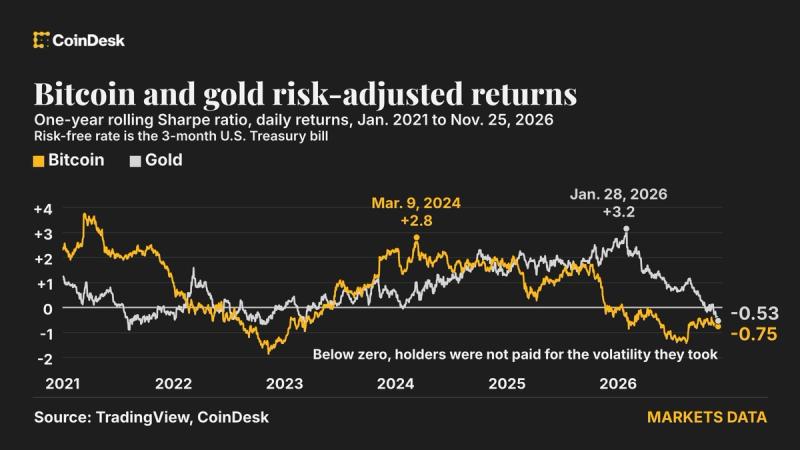
Gold has lost its risk-adjusted haven advantage over bitcoin as both now post negative one-year Sharpe ratios, with Federal Reserve policy and attractive cash yields reshaping the safe-haven calculus for investors.
Executive Takeaways
- Gold has surrendered the risk-adjusted advantage that made it the preferred haven over bitcoin through much of the current cycle.
- Both assets now register negative one-year Sharpe ratios, meaning their returns have not compensated holders for the volatility endured.
- Federal Reserve policy—persistently elevated rates and a higher-for-longer posture—has lifted the risk-free cash yield above what either asset offers on a risk-adjusted basis.
- Cash and short-duration Treasuries have become the pragmatic haven, complicating the long-running gold-versus-bitcoin debate.
- Investors should watch Fed guidance, real yields, and ETF flow data as the key signals for when the haven hierarchy may reorder again.
Section 1: The Core Event & Breaking Timeline
The long-running argument over which asset deserves the mantle of digital-age haven—gold or bitcoin—has reached an uncomfortable stalemate. According to data surfaced by CoinDesk, gold has lost the risk-adjusted advantage that made it this year's haven of choice over bitcoin. The two assets now share a common distinction that neither camp will relish: both offer negative one-year Sharpe ratios, a measure that compares returns against the volatility taken to achieve them. In plain terms, holders of both gold and bitcoin have been paid poorly for the stomach-churning ride.
The Sharpe ratio, developed by Nobel laureate William Sharpe, divides an asset's excess return over the risk-free rate by the standard deviation of its returns. A negative reading means the asset underperformed cash on a volatility-adjusted basis. That both gold and bitcoin now sit in negative territory is a striking convergence for assets that are usually pitched as opposites—one the ancient store of value, the other the volatile newcomer.
The immediate market reaction has been less a panic than a quiet reallocation. Flows into money-market funds and short-duration Treasuries have remained robust as investors recognize that cash yields, anchored by Federal Reserve policy, offer a competitive return with far less drama. Gold's retreat from its haven pedestal has been gradual rather than abrupt, reflecting a grinding repricing rather than a single shock.
The timeline matters here. Through the tightening cycle, gold initially held up better than bitcoin, reinforcing the traditionalist case that the metal is the steadier refuge. But as rates stayed elevated and real yields climbed, gold's own risk-adjusted appeal eroded. Bitcoin, meanwhile, continued to trade as a high-beta risk asset, amplifying moves in both directions. The result is a rare moment of parity in underperformance—a convergence that reframes the entire haven debate.
Section 2: Deep Technical & Financial Architecture
Understanding why both assets now post negative Sharpe ratios requires unpacking the mechanics of the calculation. The numerator is the asset's return minus the risk-free rate; the denominator is the volatility of those returns. When the risk-free rate is high—as it has been with the Fed's policy stance—the hurdle for any risky asset rises. Gold and bitcoin must now clear a higher bar to justify their volatility, and neither has done so over the trailing year.
For gold, the balance-sheet impact is felt most acutely by allocators who use the metal as a portfolio ballast. Gold pays no yield, so its entire return depends on price appreciation. When real yields are positive and rising, the opportunity cost of holding a non-yielding asset increases. That dynamic compresses gold's risk-adjusted return even if its nominal price holds steady. Central bank buying has provided a floor, but it has not restored the Sharpe advantage.
Bitcoin's architecture compounds the problem. Its fixed supply and halving schedule are designed to create scarcity, but its price discovery remains dominated by liquidity conditions and risk appetite. In a higher-for-longer regime, bitcoin behaves less like digital gold and more like a leveraged bet on loosening financial conditions. Its volatility remains multiples of gold's, so even comparable nominal returns produce a far worse Sharpe reading.
Unit economics tell the story. Consider a simplified comparison table:
- Gold: No yield; return driven by price; lower volatility; historically positive Sharpe in risk-off regimes.
- Bitcoin: No yield; return driven by price and adoption; high volatility; Sharpe highly sensitive to drawdowns.
- Cash/T-bills: Explicit yield; near-zero volatility; now competitive or superior on a risk-adjusted basis.
The technology stack and market plumbing reinforce the divergence in perception. Gold trades through deep, centuries-old OTC and futures markets with central bank participation. Bitcoin trades across a fragmented but rapidly institutionalizing stack of spot ETFs, derivatives, and exchanges. Both are now accessible to the same allocators, which makes the Sharpe comparison directly actionable—and directly damning when both readings turn negative.
Section 3: Industry & Global Market Ripple Effects
The ripple effects are already visible across the asset management industry. Gold ETF providers face a harder pitch when the metal's risk-adjusted case weakens. Bitcoin ETF issuers, meanwhile, must defend a product whose volatility has historically been its selling point and its liability. Both camps are now competing against a simpler alternative: cash yielding a real return.
For investors, the shift reopens the classic debate about portfolio construction. A negative Sharpe ratio does not mean an asset is worthless—it means the trailing period was unkind on a risk-adjusted basis. Long-horizon allocators may still hold gold as insurance and bitcoin as asymmetric upside. But tactical allocators, who dominate short-term flows, are more likely to park capital in Treasuries until the risk-adjusted math improves.
Supply chains and adjacent markets feel the change too. Gold miners face margin pressure when the metal's real return lags. Crypto infrastructure firms—exchanges, custodians, and market makers—see volumes tied to volatility, which cuts both ways. A calmer bitcoin with a poor Sharpe ratio may mean less trading revenue even as institutional custody grows.
Globally, the haven hierarchy is being tested in real time. Emerging-market central banks continue to accumulate gold as reserve diversification, a structural bid that transcends Sharpe ratios. Bitcoin's adoption in developing economies as an inflation hedge persists, but it remains a minority allocation. The ecosystem shift is subtle: the conversation is moving from 'which is the better haven' to 'whether either beats cash right now.'
Section 4: Critical Perspectives, Analyst Debates & Risk Factors
Not everyone reads the Sharpe convergence the same way. Gold traditionalists argue that a one-year window is too short to judge a monetary asset with millennia of history. They note that gold's drawdowns have been shallower than bitcoin's and that central bank demand provides a structural floor. For them, the negative Sharpe is a cyclical artifact of Fed policy, not a verdict on gold's role.
Bitcoin advocates counter that the metal's stability is precisely its limitation. They argue that bitcoin's volatility is the price of asymmetric upside and that risk-adjusted metrics penalize assets with fat right tails. A negative Sharpe in a tight-money regime, they contend, says more about the Fed than about bitcoin's long-term adoption curve.
Risk factors cut across both camps. The biggest is the path of Fed policy: if rates fall and real yields compress, the risk-free hurdle drops and both assets could see their Sharpe ratios recover. Conversely, a prolonged higher-for-longer stance keeps cash king. Liquidity conditions, regulatory friction around crypto, and physical gold market dislocations are additional variables.
Regulatory friction remains a wild card for bitcoin, particularly around ETF flows and custody rules. For gold, the risks are more macro—dollar strength, real yields, and central bank behavior. The honest analyst conclusion is that neither asset currently offers a compelling risk-adjusted case, and that the debate has shifted from ideology to arithmetic.
Section 5: Strategic Forecast & Road Ahead
Over the next 12 to 24 months, the key variable is the Federal Reserve. If the central bank pivots toward easing and real yields fall, the risk-free hurdle declines and both gold and bitcoin could reclaim positive Sharpe territory. The sequencing matters: gold typically responds to real yields first, while bitcoin tends to react to liquidity and risk appetite with a lag.
Upcoming milestones to watch include Fed meeting guidance, inflation prints, and real yield trends. On the crypto side, ETF flow data and institutional custody announcements will signal whether allocators are treating bitcoin as a strategic or tactical holding. On the gold side, central bank purchase data and ETF holdings will reveal whether the structural bid persists.
What to watch most closely is the cash alternative. As long as T-bills offer a real return with minimal volatility, both gold and bitcoin must clear a high bar to justify inclusion on risk-adjusted grounds. A sustained drop in cash yields would be the clearest catalyst for a haven hierarchy reshuffle.
The road ahead is less about declaring a winner than about recognizing a regime. In a high-rate world, cash is the benchmark every haven must beat. Gold and bitcoin are both on trial—and for now, the jury is still out on whether either deserves the crown.




Comments (0)
No comments yet. Be the first to share your thoughts!
Leave a Comment