From Programming to AI Orchestration: Why the Future Belongs to Systems Directors, Not Syntax Coders
Three decades after computerization transformed global business, software engineering is facing an even greater cognitive revolution. Is AI killing programming jobs? Rajeendran Mampatta analyzes why the craft of manual syntax generation is being eclipsed by autonomous multi-agent orchestration, and why future developers must evolve into systems directors.

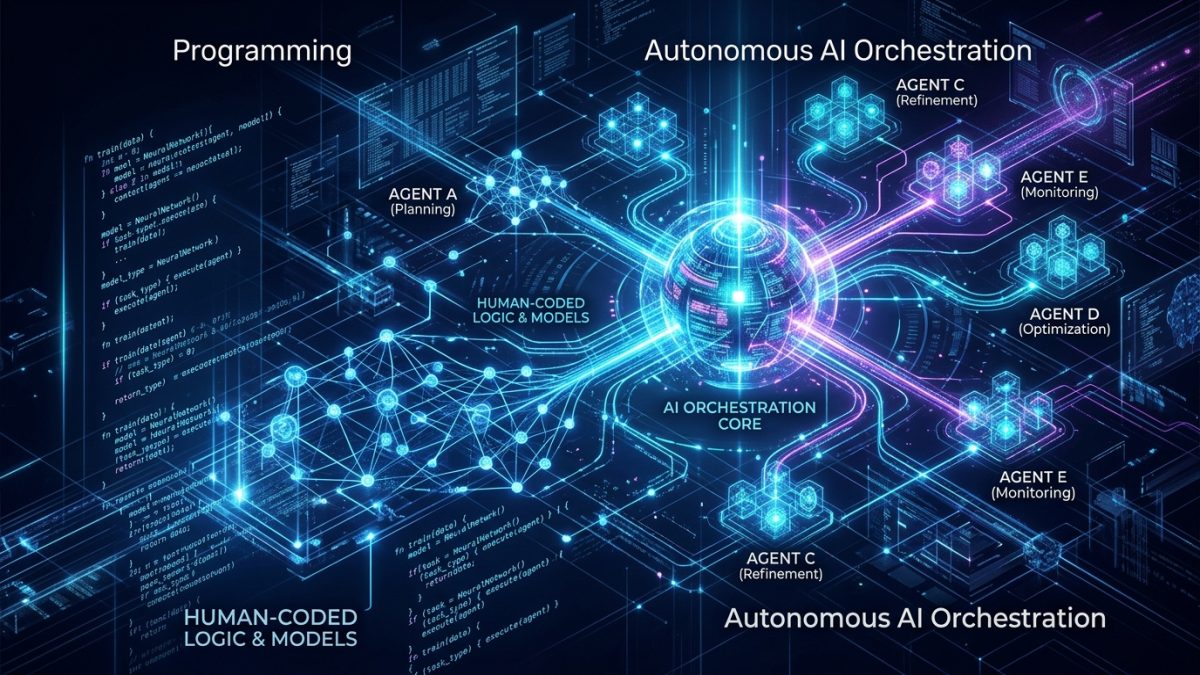
Three decades ago, the dawn of widespread computerization fundamentally disrupted global commerce. Sceptics feared personal computers and automated spreadsheets would hollow out corporate offices and render white-collar workers obsolete. Instead, the opposite occurred: by equipping people with computing devices, it unlocked massive economic growth and created an entirely new job market in information technology.
Now, we face a profoundly different paradigm. Machines are no longer passive calculating devices waiting for procedural, line-by-line commands. They possess reasoning, semantic understanding, and autonomous problem-solving capabilities that multiply execution speed by orders of magnitude while simultaneously shifting traditional workforce requirements.
Naturally, the inevitable question dominates boardrooms, engineering campuses, and tech forums: Is artificial intelligence killing software engineering jobs?
The short answer is an emphatic no. Instead, the entire orientation of the software industry is undergoing an irreversible structural revolution. The era of the sluggish, six-month team project is over. Today, the market demands rapid prototyping, autonomous validation, and immediate, tangible results.
Key Takeaway
Speed is no longer an internal engineering metric—it is the baseline survival criteria. When intelligent systems can generate, test, and refactor boilerplate code in seconds, the commercial value of manual syntax typing plummets to near zero.
Upskilling vs. Orientation: The Real Dilemma
When faced with rapid disruption, IT professionals routinely ask the wrong question: Should I focus on upskilling or mere survival?
The truth is, neither approach addresses the root issue. With a groundbreaking AI framework, library, or frontier model released almost daily, keeping up with every single tool is practically impossible. Attempting to achieve tool-by-tool mastery is a treadmill that moves faster than any human can sprint, leading directly to intellectual exhaustion.
The real key is not hyperactive upskilling—it is strategic cognitive orientation.
"A developer's true leverage no longer comes from memorizing syntax or syntax idioms, but from orchestrating multiple AI agents in a scalable environment. If you understand system development principles and can visualize a product all the way from conception to production, you possess the right mindset for modern AI-driven development. Relying solely on basic prompt engineering is no longer enough for a long-term career."
Orientation means possessing deep foundational comprehension of system design, data architecture, security boundaries, and domain logic. If you understand how data flows from ingestion to persistence, and you can clearly conceptualize an entire product lifecycle from inception to high-availability deployment, you possess the orientation needed to command AI systems effectively.
The Great Shift: Syntax Coder vs. AI Orchestrator
| Strategic Dimension | The Traditional Coder (2015) | The AI Orchestrator (2026) |
|---|---|---|
| Primary Value Asset | Syntax memorization, framework APIs | Systems thinking, architectural design & verification |
| Workflow Dynamic | Writing procedural code line-by-line | Deploying & directing autonomous agent swarms |
| Delivery Cadence | 3 to 6-month quarterly release cycles | Hours to days from concept to deployed prototype |
| Scope of Ownership | Isolated Jira tickets / single-layer stack | End-to-end product architecture & automated CI/CD |
| Core Metric | Lines of code (LOC) and commit volume | Problem decomposition & autonomous velocity |
The Power of Multi-Agent Orchestration
Successfully solving complex business problems requires stepping back and looking at the big picture. Single-prompt interactions with chatbots represent the infancy of AI adoption; enterprise-grade software execution requires Multi-Agent Orchestration (MAS)—the coordinated deployment of specialized, autonomous subagents operating within structured guardrails.
1. Beyond Basic Prompts
Anyone can write a prompt, but orchestrating agents at scale requires rigorous architectural vision. An orchestrator designs the state machine, sets data verification contracts, and coordinates multiple specialized agents—such as a researcher agent exploring documentation, a backend implementer, an aggressive automated adversarial tester, and a security auditor—to work synchronously toward a verified outcome.
3. Focus on Outcomes
Instead of getting bogged down in boilerplate code, debugging typos, and scaffolding test suites, the focus shifts entirely to directing intelligent systems to build, test, and ship faster. The engineering bottleneck has moved from implementation capacity to validation and architectural clarity.
The Evolving Career Paradigm: From Employees to High-Leverage Operators
This technological leap is fundamentally restructuring the modern employment landscape. We are moving away from traditional, rigid corporate hierarchies toward an agile, high-velocity talent economy.
Armed with the leverage of AI utilities, engineers are evolving beyond traditional full-time, single-desk roles:
- The Solopreneur Explosion: Solo developers and micro-teams can now conceive, launch, and scale commercial software products that previously required venture funding and thirty full-time employees.
- The High-Value AI Contractor: Enterprises are increasingly engaging agile, specialized contractors who can parachute in, orchestrate complex automated workflows in weeks, and deliver working solutions without bloated overhead.
- The Strategic Tech Director: Inside larger firms, senior engineers are transitioning into technical directors—reviewing agent-generated code diffs, ensuring security and compliance, and aligning automated systems with strategic business objectives.
The Final Verdict
The narrative that artificial intelligence will destroy software engineering fundamentally misjudges the nature of technological evolution. Just as high-level compilers eliminated machine-code punch cards without eliminating software developers, AI is eliminating manual toil so engineers can build bigger, bolder, and more ambitious systems.
The future doesn't belong to those who write the most lines of code. It belongs to those who know how to orchestrate the intelligence building them.
Rajeendran Mampatta is a senior enterprise IT architect and AI Specialist with over 18 years of technical leadership across distributed systems, cloud computing, and artificial intelligence. He specializes in Agentic Workflows, Model Context Protocol (MCP), zero-trust security, and scalable microservice architectures. Connect via LinkedIn or email: rajeendran.mampatta@gmail.com




Comments (0)
No comments yet. Be the first to share your thoughts!
Leave a Comment