UBS Exposes $20 Trillion White House Investment Boom as Foreign Takeover Spree
UBS economist Arend Kapteyn reports that new foreign direct investment in the US totaled just $232 billion in 2025, about $30 billion below its 10-year average and lower in real terms than any pre-pandemic year. The findings contradict President Trump's claim of over $20 trillion in foreign investment, with 94% of new FDI going to acquisitions of existing US firms rather than new business creation or expansion.
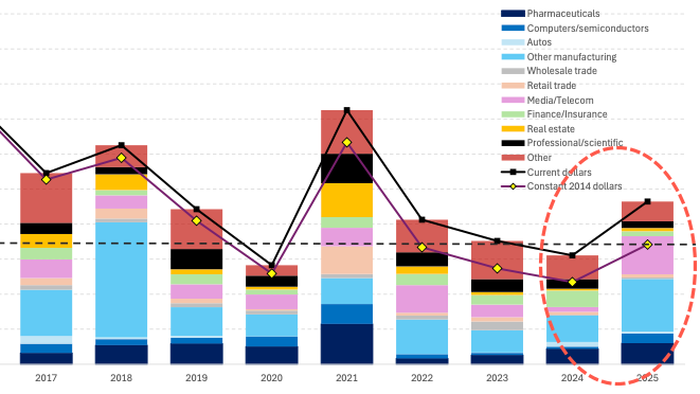
UBS economist Arend Kapteyn on Thursday challenged the White House's narrative of a foreign investment boom, revealing that new foreign direct investment (FDI) into the United States totaled only $232 billion in 2025—roughly $30 billion below its 10-year average and, when adjusted for inflation, lower than in any pre-pandemic year. The findings directly contradict President Trump's recent claim that over $20 trillion in foreign investment has flowed into the US during his second term, a figure he said could reach $25 trillion by the end of his term.
Kapteyn's analysis of Bureau of Economic Analysis (BEA) data shows that 94% of new foreign investment took the form of acquisitions of existing US firms, with only 2% reflecting the creation of new businesses and 4% the expansion of existing foreign-owned operations. While there was a modest pickup relative to 2022-24, driven mainly by media/telecoms and primary metals, Kapteyn found no broad-based investment surge. The White House tracker lists trillions in announced commitments from countries including the UAE, Qatar, Japan, Saudi Arabia, India, and South Korea, but Kapteyn noted that little of this is visible in the actual FDI data.
The gap between announced pledges and actual spending may partly reflect the lag between commitments and disbursements, but the larger question remains how much of that money will finance new US production capacity rather than simply changing ownership of existing assets. The discrepancy underscores concerns that the administration's onshoring agenda may be more rhetoric than reality, with foreign capital largely acquiring American companies instead of building new factories. UBS's findings are likely to fuel debate over the effectiveness of the White House's economic policies ahead of the 2026 midterm elections.




Comments (0)
No comments yet. Be the first to share your thoughts!
Leave a Comment