PHE Minister Inaugurates Two-Day National Seminar on Youth and Culture in Northeast India
Prof. Lalnilawma, Minister of State for Public Health Engineering (PHE), today inaugurated a two-day National Seminar on “Youth and Culture in Northeast India: Intersections and Perspectives,” jointly organised by Government Aizawl North Co
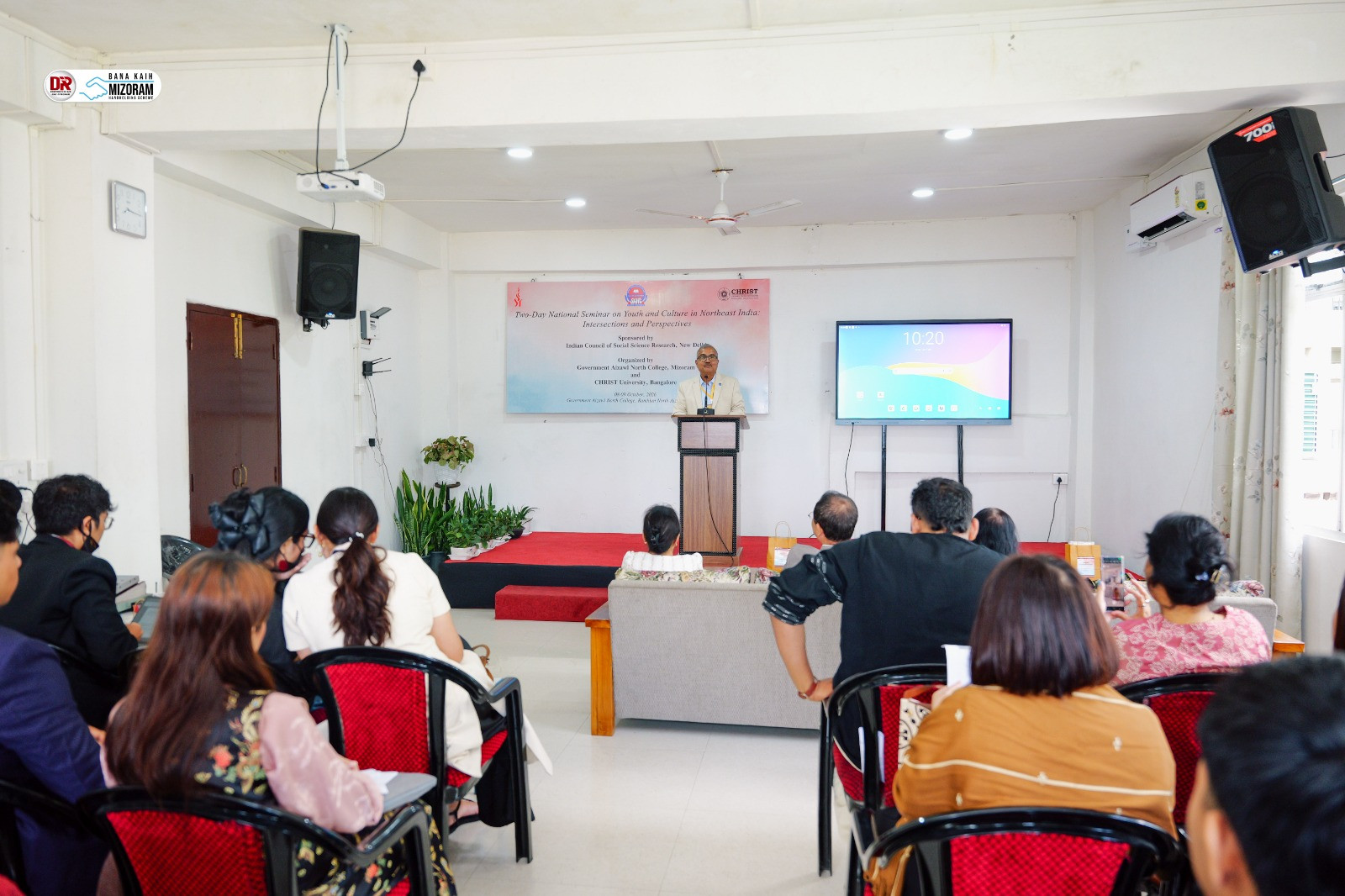
Aizawl, October 8, 2026: Prof. Lalnilawma, Minister of State for Public Health Engineering (PHE), today inaugurated a two-day National Seminar on “Youth and Culture in Northeast India: Intersections and Perspectives,” jointly organised by Government Aizawl North College (GANC), Mizoram and Christ University, Bengaluru.
In his address, Prof. Lalnilawma emphasised that Northeast India is an integral part of the country and has immense potential to contribute to India’s overall development. He highlighted the region’s rich cultural diversity, indigenous communities, distinct languages, traditions, creativity, hospitality and strong sense of community as some of its greatest strengths.
The Minister commended the organisers for providing a platform for academic exchange, research and collaboration. He observed that the seminar’s theme was particularly relevant, as young people are actively shaping cultural practices through music, fashion, literature, social media and civic engagement.
Highlighting the evolving relationship between tradition and modernity, he noted that technological advancements, digital media, education, migration and changing social environments have significantly influenced young people’s lives. He encouraged participants to explore ways to preserve and strengthen the region’s cultural identity while adapting positively to contemporary changes.
The Minister also highlighted the growing influence of social media and artificial intelligence (AI), acknowledging their potential to support education, creativity, research and development while cautioning against their misuse. He stressed the importance of equipping young people to use these technologies responsibly and critically, particularly in addressing challenges such as misinformation and digitally manipulated content.
He further observed that the seminar would provide opportunities for researchers, academics and participants from different states to exchange ideas, establish academic networks and foster future collaborations. He emphasised that the seminar’s success should be measured not merely by research presentations, publications or academic achievements, but also by its lasting positive impact on young people’s attitudes, character, behaviour and understanding of their cultural heritage.
Concluding his address, the Minister extended his best wishes for the successful conduct of the seminar and called upon participants to become agents of positive change, contributing to the preservation of cultural traditions and the development of Northeast India and the country as a whole.
Prof. Kandarpa Das, Vice-Chancellor of GCU, Assam, highlighted the importance of understanding young people as active participants in shaping contemporary society rather than merely as the future of the nation. He emphasised that Northeast India’s rich cultural and linguistic diversity is a living heritage that younger generations must reinterpret and sustain amid rapid technological and social changes.
He also highlighted how digital media creates opportunities for cultural expression, while stressing the need to address challenges relating to cultural identity, social inclusion, gender equality and youth mental health. He called upon educational institutions to foster critical thinking, cultural understanding and social responsibility, enabling young people to develop global competencies while contributing to their communities.
In her keynote address, Ms. Mitra Phukan, author, columnist and translator, emphasised the role of young people as change-makers in preserving and revitalising the cultural heritage of Northeast India. She described culture as a living and evolving tradition that must adapt to contemporary realities while retaining its historical roots and identity.
She highlighted how digital media, music, literature, fashion, tourism and creative industries enable young people to promote the region’s cultural diversity to wider audiences. She also stressed the importance of improving regional connectivity, fostering intercultural understanding, promoting social harmony and strengthening environmental awareness. She encouraged young people to embrace innovation while preserving their cultural identities and contributing meaningfully to regional and national development.
During the inaugural session, Dr. Saroj Laldinpuii, Principal of Government Aizawl North College, delivered the welcome address. The programme also featured panel discussions with Pu F. Vanlalrochana, MPS and writer; Ms. Bidisha Mahanta, Executive Director of Zubaan; and Dr. Kedilezo Kikhi, Professor in the Department of Sociology at North-Eastern Hill University (NEHU). Parallel sessions for research paper presentations were also held.
The two-day seminar seeks to examine evolving youth cultures in Northeast India through interdisciplinary perspectives. Its objectives include exploring how young people negotiate identity, tradition and globalisation; analysing the role of digital media in shaping youth expression and community formation; discussing the socio-economic and psychological challenges affecting young people; highlighting youth participation in civic engagement, activism and cultural innovation; promoting collaborative research networks on Northeast youth studies; and generating policy-relevant insights for inclusive youth development.
Source & Wire Service: Prasar Bharati SHABD (DD / Akashvani News)
Senior Tech & Market Analyst at Incisor News, specializing in sovereign technology, global semiconductor supply chains, macroeconomics, and algorithmic financial infrastructure. Providing rigorous reporting and strategic analysis on emerging tech architectures and global financial markets.


Comments (0)
No comments yet. Be the first to share your thoughts!
Leave a Comment