A quarter century of vision, service & nation-building
Spanning manufacturing, sanitation, digital payments, and cultural heritage, PM Modi’s 25 years in executive office highlight a vast spectrum of transformative programs and policy shifts.
8 views
🎧 Listen to Story
Click play to listen to audio edition
SLUG: 25 YEARS OF PM MODI
Synopsis: Spanning manufacturing, sanitation, digital payments, and cultural heritage, PM Modi’s 25 years in executive office highlight a vast spectrum of transformative programs and policy shifts.
New Delhi, October 7: In October 2001, Narendra Modi took charge as the Chief Minister of Gujarat. During his tenure, initiatives such as the Vibrant Gujarat Global Summit, Jyotigram Yojana and programmes for water management and rural development became part of the state’s development agenda.
The Vibrant Gujarat Summit, first held in 2003, was positioned as a platform to attract investment and promote Gujarat as a business destination.
In 2014, Prime Minister Narendra Modi took charge as the Prime Minister of India.
At the national level, the focus expanded across manufacturing, infrastructure, financial inclusion and digital connectivity.
One of the early national initiatives was Make in India, launched in September 2014.
The programme sought to encourage investment, innovation, infrastructure and manufacturing in India, with the objective of making the country a global manufacturing hub.
It was followed by measures including Production Linked Incentive schemes across 14 sectors.
According to government data, as of December 2025, PLI schemes had attracted more than Rs 2,16,000 in investment, with production and sales exceeding Rs 20 lakh crore and employment generation of more than 14 lakh.
The manufacturing push has also been linked with the broader objective of Atmanirbhar Bharat.
Another major campaign began on October 2, 2014.
The Swachh Bharat Mission placed sanitation and cleanliness at the centre of a nationwide public campaign. The mission focused on household toilets, eliminating open defecation and improving sanitation infrastructure.
Its second phase has placed greater attention on sustaining open defecation free outcomes and improving the scientific management of solid and liquid waste.
The initiative also sought to make cleanliness a matter of public participation, rather than only a government responsibility.
Technology has been another major component of this period.
The Jan Dhan, Aadhaar and Mobile framework, widely known as JAM, helped connect banking, identity and mobile technology with welfare delivery.
Digital payments expanded rapidly through the Unified Payments Interface (UPI).
According to NPCI data, UPI recorded more than 24.5 billion transactions in August 2026, with a transaction value of nearly Rs 29.8 lakh crore.
Digital public infrastructure has also expanded into areas such as government services, digital documents, education and healthcare.
The broader objective has been to use technology for faster access to services and greater digital connectivity.
Economic policy during this period has also included major structural changes.
The Goods and Services Tax (GST), introduced in 2017, created a common indirect tax framework across the country.
The Insolvency and Bankruptcy Code established a time bound framework for insolvency resolution.
Alongside these reforms, infrastructure expansion has included highways, airports, rail connectivity and the PM Gati Shakti National Master Plan.
The stated long term objective now includes the vision of Viksit Bharat 2047.
Alongside economic and technological initiatives, cultural heritage has remained a visible part of Prime Minister Modi’s public engagement.
Projects at major pilgrimage centres have included the redevelopment of the Kashi Vishwanath Corridor, Mahakal Lok and work related to Kedarnath.
The Ram Mandir in Ayodhya was consecrated on January 22, 2024, in a ceremony attended by PM Modi.
Yoga has also been projected internationally as part of India’s cultural outreach.
The United Nations declared June 21 as the International Day of Yoga in 2014, following India’s proposal.
Environmental policy has formed another important part of this period, with India committing to achieving net zero emissions by 2070.
International initiatives associated with India include the International Solar Alliance and the Coalition for Disaster Resilient Infrastructure.
At home, the expansion of solar and wind energy has been accompanied by programmes aimed at increasing renewable energy capacity.
Wildlife conservation has included established programmes such as Project Tiger and Project Elephant, along with the more recent Project Cheetah, which brought cheetahs to India as part of an effort to establish a viable population.
From manufacturing to sanitation, from digital payments to infrastructure, and from cultural heritage to environmental initiatives, the last 25 years of PM Modi’s journey in executive office have seen a wide range of programmes and policy interventions.
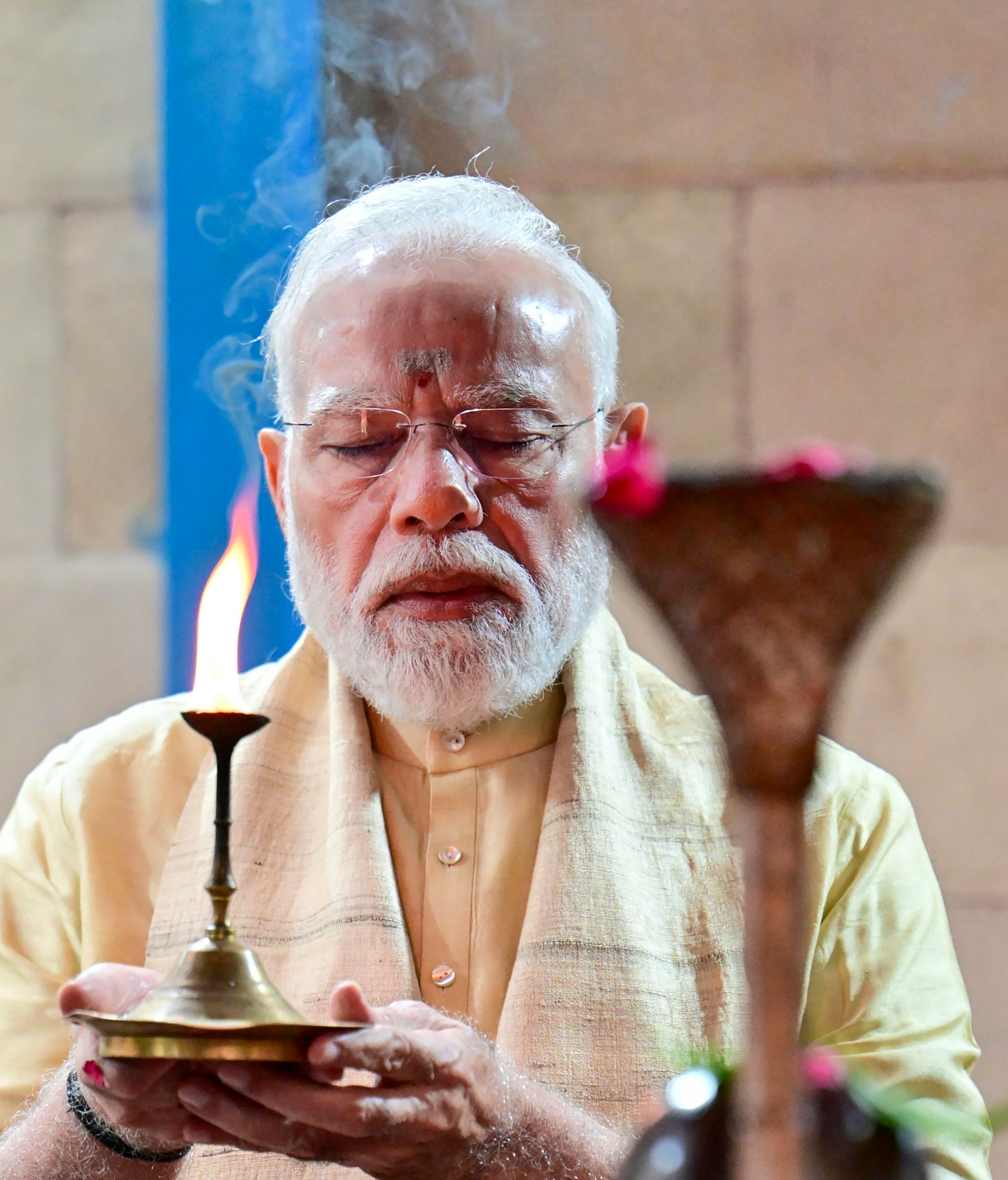
caption: Prime Minister Narendra Modi offers prayers at Shri Vinayak Mandir in Sarojini Nagar, New Delhi, on Wednesday.
credit: PMO
Source & Wire Service: Prasar Bharati SHABD (DD / Akashvani News)
Jaison M K
Senior Tech & Market Analyst
Senior Tech & Market Analyst at Incisor News, specializing in sovereign technology, global semiconductor supply chains, macroeconomics, and algorithmic financial infrastructure. Providing rigorous reporting and strategic analysis on emerging tech architectures and global financial markets.
Comments (0)
No comments yet. Be the first to share your thoughts!
Leave a Comment