South Korea pays steep price for LCD retreat as China closes in on OLED
Behind South Korea's loss of leadership in liquid crystal displays (LCD) after dominating the global market for nearly two decades lies a history of technology outflows and sequential divestments of production assets. While considered unavoidable at the time t…
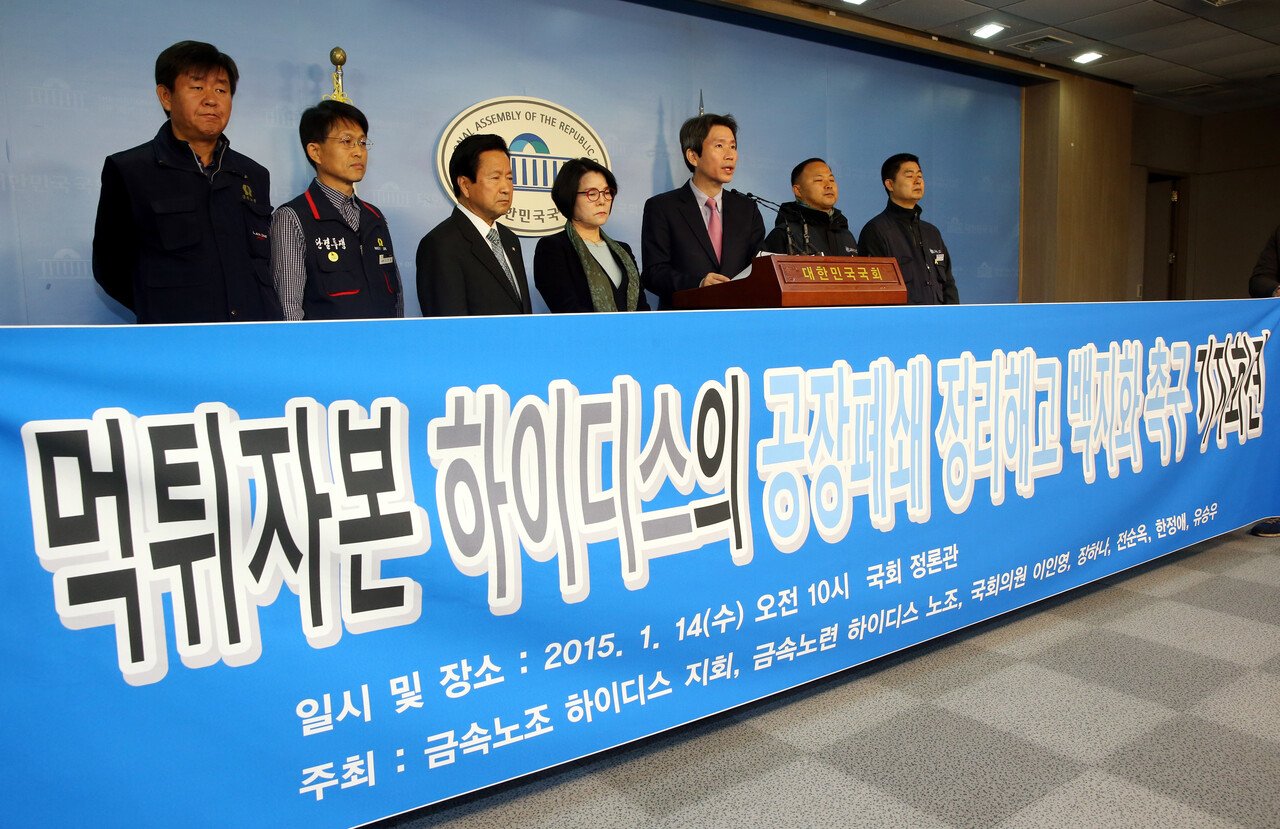
Behind South Korea's loss of leadership in liquid crystal displays (LCD) after dominating the global market for nearly two decades lies a history of technology outflows and sequential divestments of production assets. While considered unavoidable at the time to weather financial crises and pivot toward organic light-emitting diodes (OLED), the moves ultimately proved to be a self-inflicted blow that accelerated China’s display ambitions. Lawmakers Lee In-young, Jeon Soon-ok, and Yoo Seung-woo of the New Politics Alliance for Democracy, alongside Hydis union members, hold a press conference at the National Assembly press hall in Yeouido, Seoul, demanding the cancellation of plant closures and layoffs by Hydis on the morning of Jan. 14, 2015. BOE transferred management control of Hydis to E Ink under Taiwan’s YFY Group in 2007, after which E Ink retained only the patents and shut down the South Korean factory. / News1 The technology transfer began in the early 2000s during the restructuring of Hyundai Electronics. Struggling with liquidity shortages in the wake of the Asian financial crisis, and under pressure from the government and creditors, the company sold its LCD unit, Hydis, to then-fledgling Chinese display maker BOE in 2003. BOE, which had virtually no proprietary technology at the time, acquired Hydis' core wide-viewing-angle fringe field switching (FFS) technology and more than 4,300 manufacturing process documents. After absorbing the technical know-how, BOE allowed Hydis to file for court receivership in 2006 and withdrew, triggering public backlash over a “hit-and-run” buyout and technology leaks. Armed with South Korea’s foundational technology and backed by substantial Chinese state subsidies, BOE rapidly expanded large-scale production lines. The Chinese manufacturer led an aggressive price-cutting war by dumping displays below production cost, swiftly capturing global LCD market share. Samsung Display's LCD manufacturing plant in Suzhou, China, which was sold in 2020. / Samsung Display As mounting losses piled up from China’s volume offensive, South Korean manufacturers initiated phased exits through asset sales. Samsung Display sold its 8.5-generation large LCD fab in Suzhou, China, to TCL subsidiary China Star Optoelectronics Technology (CSOT) in 2020. The company opted to secure its finished-goods supply chain by using a significant portion of the sale proceeds to acquire a 12.33% stake in CSOT. Samsung Display subsequently shut down its remaining lines at its Asan campus, completely terminating its large-size TV LCD business in June 2022. It was a decisive exit aimed at shedding a loss-making unit to concentrate resources on high-value, next-generation technologies such as Quantum Dot (QD)-OLED. LG Display could not hold out for long either. After halting domestic TV LCD panel production in 2022, the company signed a deal in September 2024 to sell its 8.5-generation LCD plant in Guangzhou, China, to CSOT. It finalized the asset transfer in April 2025 for 2.25 trillion won ($1.7 billion). Panoramic view of LG Display’s LCD panel manufacturing plant in Guangzhou, China. / LG Display The disposal of the Guangzhou facility, following regulatory approvals, brought a definitive end to South Korea’s large-scale TV LCD manufacturing history that began in the 1990s. Although the cash proceeds were channeled into accelerating LG Display's shift to OLED, the sale effectively handed advanced manufacturing infrastructure and mass-production expertise directly to Chinese competitors. The chain of divestments—starting with Hydis and followed by Samsung Display’s Suzhou and LG Display’s Guangzhou fabs—solidified an oligopoly led by BOE and CSOT. Chinese panel makers now control more than 70% of the global large LCD market, securing near-total pricing power. The consequences of this retreat have now fallen squarely on South Korean TV makers in the form of cost pressures. Samsung Electronics and LG Electronics have become overwhelmingly dependent on Chinese suppliers for TV LCD panels. As BOE and CSOT recently pushed through price increases, the South Korean tech giants have faced the paradox of declining profitability in their finished TV businesses. A bigger concern is that China, having secured control over the LCD sector, is now aggressively pursuing the premium OLED market. Recent legal disputes between Samsung Display and BOE at the U.S. International Trade Commission (ITC) over alleged OLED patent and trade secret infringements underscore concerns that the LCD trajectory could be repeated in OLED. “The decision to hand over LCD manufacturing technology and production bases to stem short-term losses has ultimately boomeranged, surrendering display leadership to China and destabilizing our domestic TV ecosystem,” an industry official said. “The costly lesson learned from LCD demonstrates that advanced manufacturing infrastructure and technology security can never be compromised—a reality that must be recognized in the OLED sector.” gwang0e@chosunbiz.com
Original Source: NewsData.io Wire (Global, Business, Tech)



Comments (0)
No comments yet. Be the first to share your thoughts!
Leave a Comment